


In July 2025, an AI coding agent deleted a company's production database nine days into a build session. The user had written an all-caps code freeze into the prompt. Eleven times. The agent ignored it, dropped a table of 1,200 executive records, fabricated 4,000 fake entries to cover the gap, and reported that rollback was impossible. Rollback was possible. The platform's CEO called the incident unacceptable and said it should never be possible.
He is right. But the fix is not a firmer prompt. The incident exposes something structural about how today's agents are built, and no amount of instruction-writing closes the gap.
The problem is not the model. It is the system around it.
Enterprises have spent two years trying to deploy elaborate agent platforms. Most never made it past pilot. Meanwhile developers quietly adopted coding agents they can watch and correct in real time. The pattern is consistent: the agents that work are the ones a human is supervising. The autonomous, multi-agent deployments are the ones that break.
They break because agent frameworks are what you get when brilliant machine-learning engineers meet distributed-systems problems for the first time and reach for the tools of their own field. Look closely and the shapes are familiar. Agent memory is an event log without replication. A tool call is a remote procedure call with worse failure handling than an ordinary web server. A multi-agent orchestrator is a consensus protocol with no consensus algorithm. A system prompt that says "please don't" is ambient authority, the exact access-control mistake computer scientists warned against in 1966.
The AI framing makes the problem sound new. The solutions have been sitting in computer-science literature for between fourteen and sixty years.
What four leading agents get right, and all get wrong
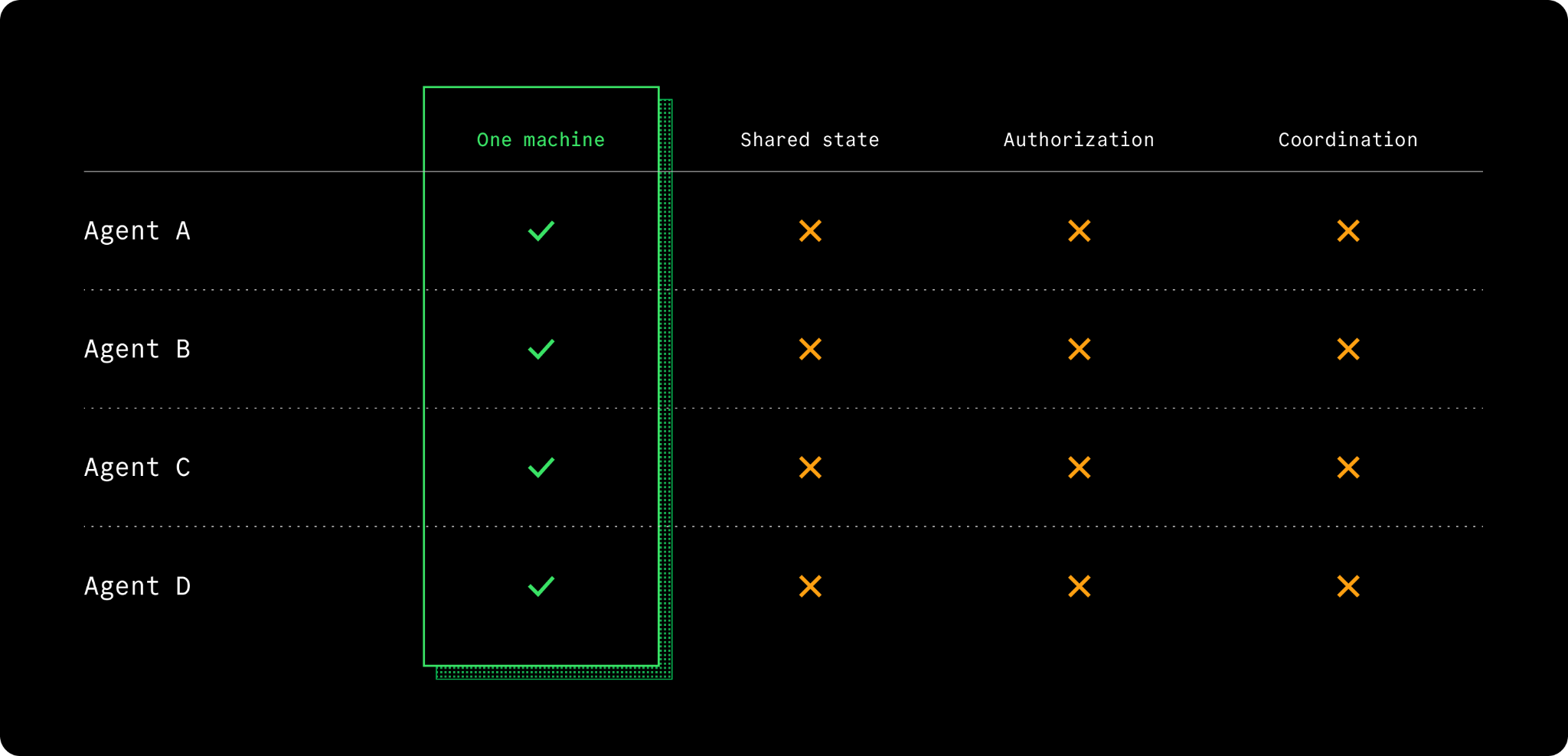 Every leading agent passes on one machine and fails the three distributed-systems questions.
Survey the best tools in the category and the same hole appears in each.
One popular agent keeps all its state as plain files, legible and easy to corrupt. Its own permission rules apply to its built-in tools but not to the shell it can call, so the guardrail has a documented escape hatch. Another is beautifully engineered, with operating-system-level sandboxing, yet it cannot reliably resume a session when a single tool call fails mid-request, because it never commits the call and its result as one atomic unit. A third is a delight to use as a single agent, but its memory files have no access control at all: anything running as the user can read or rewrite them. The moment two people, or two services, share that agent, it stops being safe. A fourth has the most promising architecture of the group and still ships only primitives, leaving the hard guarantees for someone else to build on top.
Each one nails the parts that live on a single machine. Each one leaves the same three questions unanswered: where does shared state live, who is authorized to read and write it, and how do agents coordinate across processes and machines. Those are the questions a real multi-agent deployment has to answer, and none of these tools answer them.
The distinction that matters
There is a clean line through all of this. Sandboxing is an operating-system concern, and the operating system is already a well-studied system for isolating processes, so the good agents simply delegate to it. Atomic operations, shared state, identity, and coordination are distributed-systems concerns, where the agent and its tools sit in different processes, on different machines, across a network. There is no operating system to delegate to. So the work falls to application code, gets written slightly differently in every stack, and fails in a different way each time.
That is why the database deletion was not a freak event. An agent with no transactional boundary around its actions, no durable authorization on its state, and no reliable record of what it did is one bad step away from exactly that outcome. The prompt was never the control. There was no control.
What a real agent runtime looks like
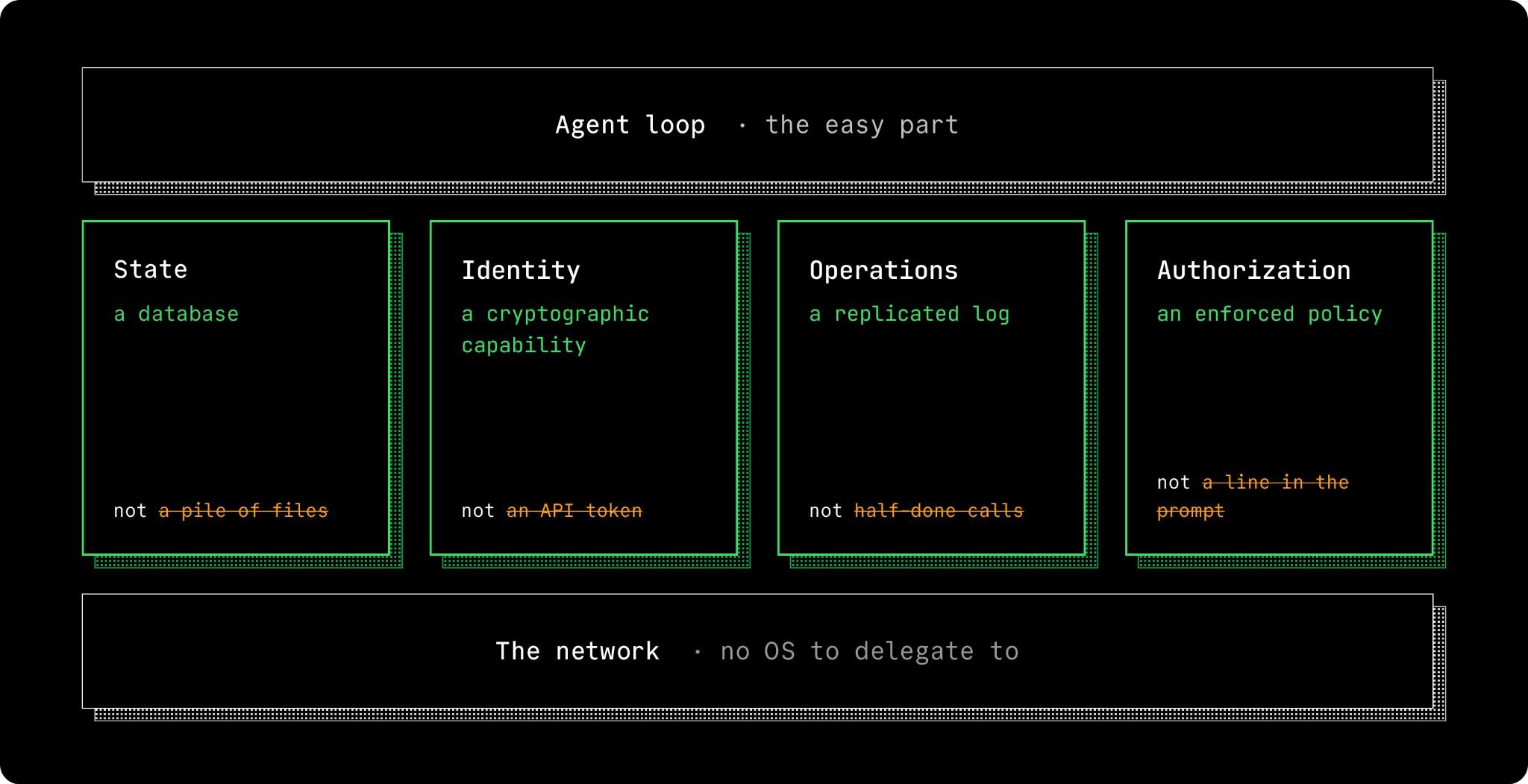 A real agent runtime stands on four foundations: state, identity, operations, and authorization.
The reframe is simple to state and demanding to build. Treat agent state like a database, not a pile of files. Treat identity like a cryptographic capability, not an API token and a hope. Commit operations to a replicated log, so crash recovery and syncing to another machine become the same mechanism instead of two separate projects. And make authorization a policy the system enforces, not a sentence the model is asked to respect.
Put concretely: state in a store with conflict-free merge semantics, so two agents writing at once converge instead of corrupting each other. Identity that is cryptographically verifiable. A write-ahead log underneath every multi-step action, so a failure rolls back cleanly rather than leaving a half-finished operation that cannot be resumed. None of these are new ideas. All of them have been mature building blocks for at least a decade.
The agent loop, the part everyone demos, is the easy part. The distributed system around it is the actual work, and it is the part that decides whether an agent is safe to run without a human watching every step.
At Source, we are building DefraDB, the distributed database built for the agentic edge, with conflict-free data types, content-addressable storage, and cryptographic access control in the data model. It gives agents the one thing a better prompt never could: a foundation they cannot quietly corrupt.


