


Every team building Edge AI hits the same wall. The model runs on the device. The hardware keeps up. The demo dazzles the room. Then the fleet grows past a handful of nodes, connectivity turns spotty, two devices disagree about the same record, and the whole system starts to wobble. The reflex is to blame the model or the network. The real culprit is almost always the database.
Not because the database is bad. Because it is in costume.
The local databases and sync engines teams reach for today are cloud databases wearing edge clothing. They were pulled out of architectures where a central server owns the truth, handed a local cache and a sync loop, and shipped to the device with one assumption still baked in: eventually, everything reports back to headquarters. Edge AI breaks that assumption in the first hour of production.
A Lineage Problem
Trace the family tree and the issue becomes obvious. Every era of computing has forced a rethink of data management, and each era grew its own shape rather than inheriting the last one.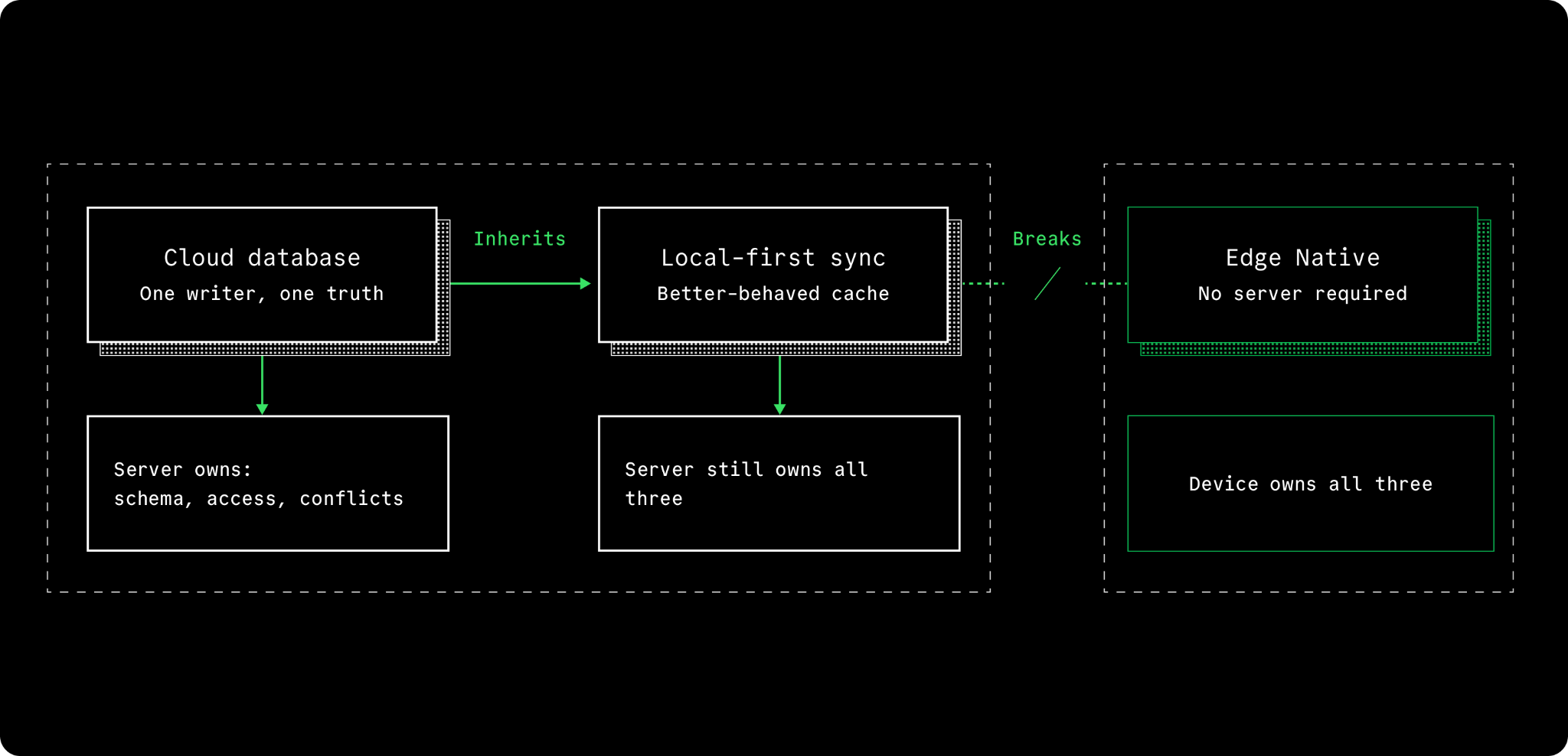
The first era is the cloud database. It assumes one writer of record, one schema, one trust boundary. A database sits behind an API, the API decides who reads what, and every device is a thin supplicant asking permission. It is excellent at what it was built for. None of it was built for a device that has to think on its own.
The second era should have been that rethink. Instead it was an extension. On-device SQLite. Mobile stores. Offline modes. Sync engines that queue local writes and replay them to a server once the connection returns. This generation is often called Local First, and the best of it draws on genuine principles. But most commercial versions kept the cloud as the source of truth and simply made the device a better-behaved cache. The server still owns the schema. The server still resolves conflicts. The server still decides access. The device got autonomy the way a teenager gets a curfew.
Edge AI demands a third era of Edge data management, and it inherits almost nothing from the first two.
What Edge AI Actually Demands
Picture real deployments. A warehouse fleet where every robot writes observations and reads its neighbors' maps. Inspection drones that land, exchange findings, and take off again. Medical devices personalizing a model on patient data that is legally forbidden from leaving the room. Grid-edge nodes balancing load against forecasts from their peers. These workloads share five demands.
Many writers, no referee. Every device produces data and may accept writes from its peers, often with no server in the loop to serialize them. The data layer has to merge concurrent writes correctly on its own. This is precisely what conflict free data types were invented for, which is why they belong inside the storage engine, not bolted on as an afterthought.
Proof, not trust. When a model's output drives a real decision, the questions come fast: which device produced this reading, has it been altered, what data shaped the call? A cloud database answers with server logs you have to trust. An edge data layer answers from the data itself. Content addressable storage makes this structural: every update is identified by a hash of its contents, so any device holding a record can verify its history with no authority to consult.
Access control that travels with the data. On-device inference means there is no API gateway standing between the model and the database. The rules about who reads what must be a property of the data, enforced wherever it lands, or they are not rules. They are suggestions.
Network as an option, not a dependency. Edge Intelligence runs in mines, aircraft, operating rooms, ships, and orbit. Offline is not the failure case a retry queue handles. Offline is Tuesday. The right data layer treats a connection as a chance to reconcile, not a requirement to function.
Tolerance for a mixed fleet. Real deployments run mixed hardware and software versions for years. A migration that assumes a coordinated fleet-wide upgrade is a migration that never completes. Schema versions have to coexist and translate between each other, indefinitely.
Remove the server and every one of those jobs, once handled centrally, lands squarely on the data layer.
Why Retrofitting Fails
The obvious counter is that today's tools will simply grow into this. Add merge logic on top of SQLite. Add signing to the sync engine. Add policy checks in the app. A whole product category is attempting exactly this, and it is real progress. But the pattern repeats: each patch works alone, and the combination collapses in production.
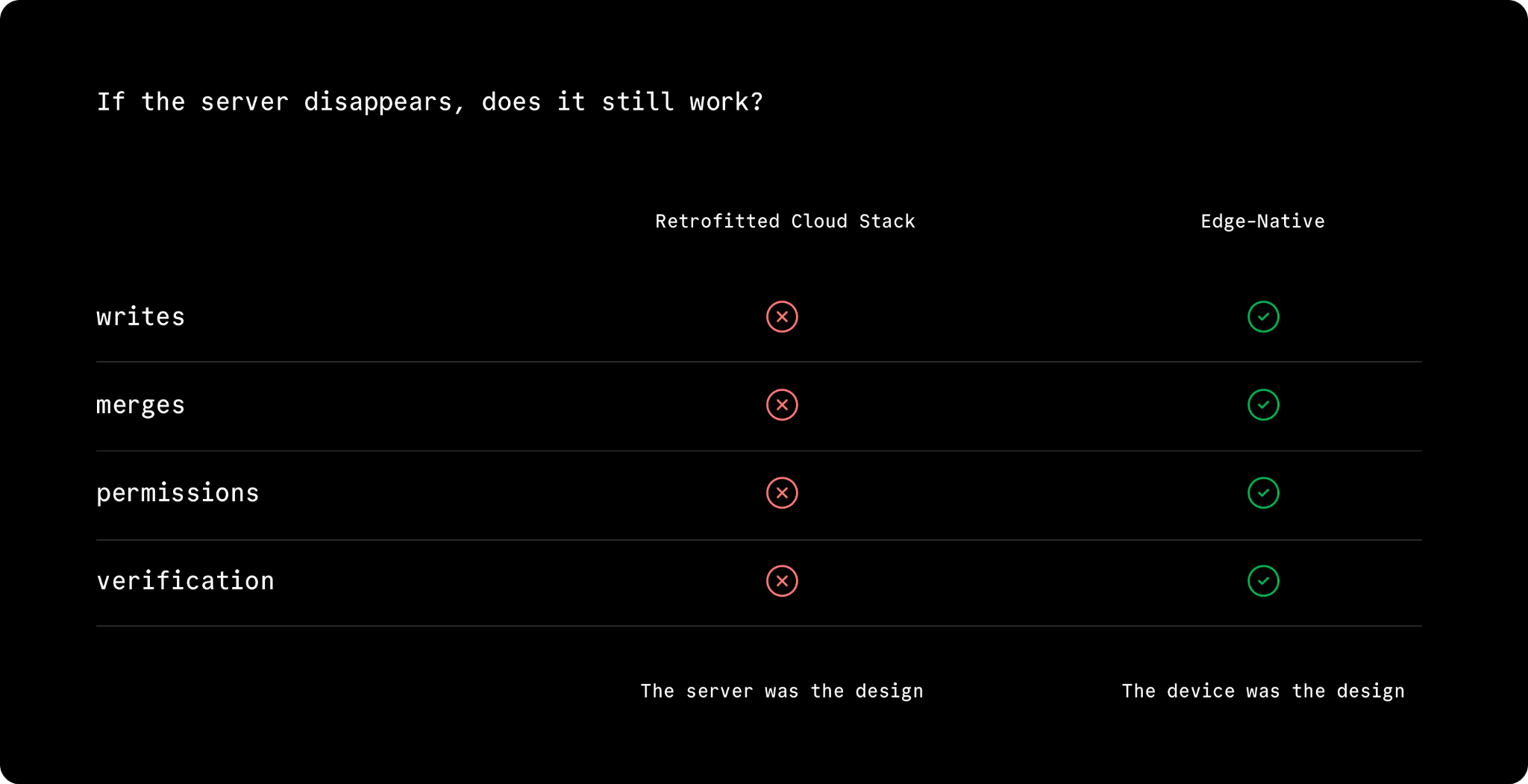
The reason is architectural, not a missing feature. A sync engine built to batch writes for a server cannot become peer-to-peer by configuration, because its conflict model assumes one authority picks winners. A single-writer database cannot become multi-writer by wrapping it, because merge behavior has to live where the data lives. Access control enforced in the app disappears the moment data syncs to a device running different code. These are load-bearing assumptions. You do not renovate a load-bearing wall by hanging a picture on it.
There is one honest test for any edge data layer: if the server disappears permanently, does the system still work correctly — writes, merges, permissions, and verification included? For the cloud lineage, the answer is no by design. The server is the design.
What Edge-Native Looks Like
Flip every inherited assumption and the solution appears. The device stops being a cache of someone else's truth and becomes a source of truth in its own right. Writes merge deterministically wherever they meet. History is verifiable by anyone holding the data. Access policy enforces itself on every node. The network becomes an opportunity, not a requirement. Schemas coexist across versions instead of demanding a migration day that never arrives. This is edge-first infrastructure, not cloud infrastructure with better manners.
This is the architecture Source built DefraDB around — an open-source, Distributed Database designed for the environment Edge AI actually inhabits. If your fleet has started to wobble in exactly these ways, run it beside whatever is wobbling and watch the difference.
The edge does not need a better cache. It needs a database that never assumed the cloud was in charge.


