

Ask most technology leaders where their AI should run, and the answer comes back on reflex: the cloud. The reasoning feels settled. Edge devices are weak. Edge devices are unreliable. Edge devices capture data; they do not compute on it.
That was true once. It is not true anymore. And the gap between what most organizations assume about the edge and what is actually running in production has become a strategic blind spot.
A drone inspecting transmission lines runs a vision model on the device. A satellite in low Earth orbit decides which images are worth transmitting before it spends the bandwidth. A solar inverter balances load in real time on a chip smaller than a credit card. None of these are demos. They are production deployments shipping today, quietly, on silicon that rarely makes the headlines.
For decision makers, this is not a hardware curiosity. It is an architecture decision hiding inside a capability assumption — and getting it wrong is now expensive.
The silicon quietly caught up
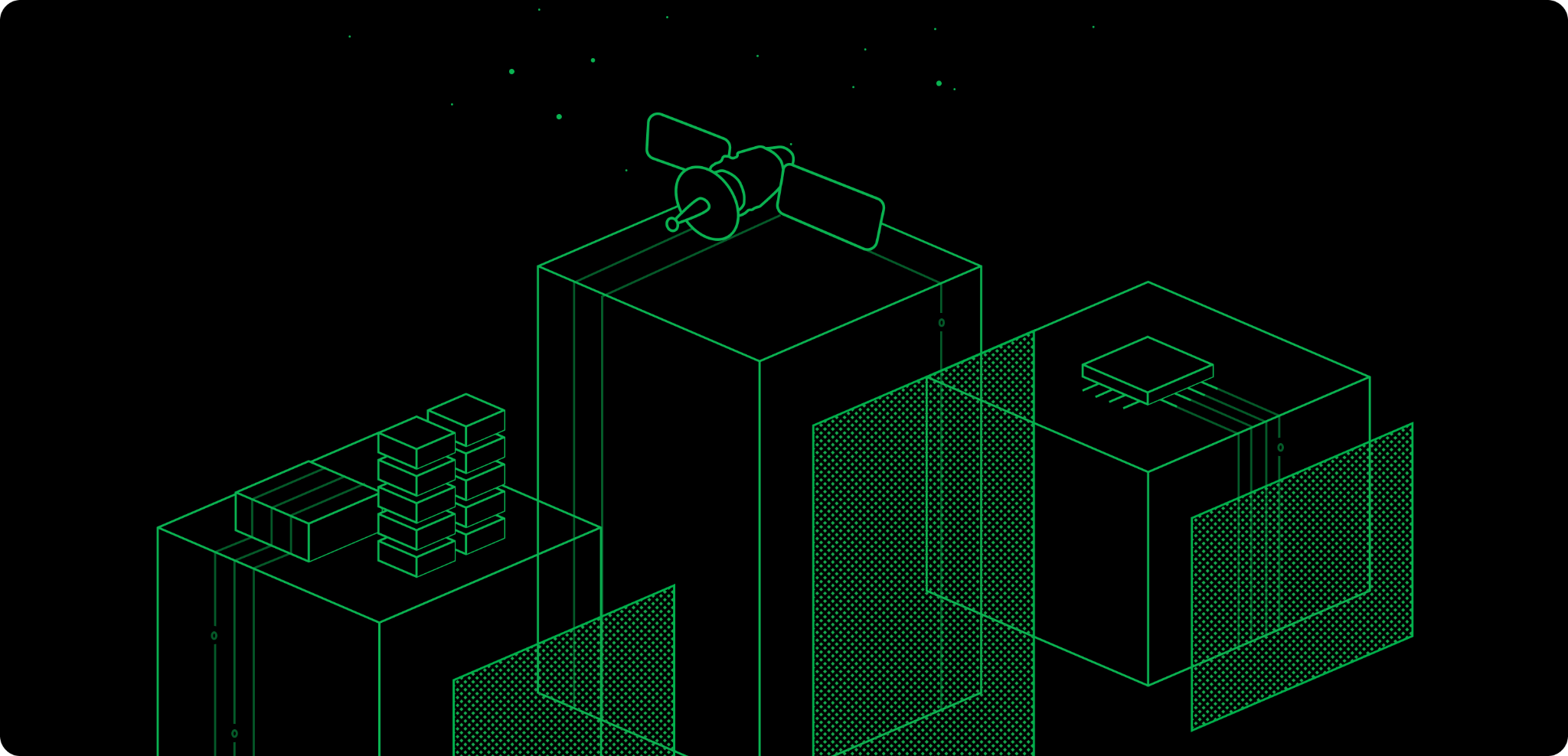
Consider the range of what now ships with intelligence built in.
At the smallest end, microcontrollers that once only read sensors now classify what those sensors detect. A Raspberry Pi with an AI accelerator handles real-time computer vision. Low-power boards run anomaly detection on a watch battery. The bottom of the stack is no longer passive.
In the industrial tier, a single module now delivers the compute that three years ago required a server rack and a network connection — in a package you can carry under one arm. This is the Edge AI silicon running in factories, warehouses, mines, hospitals, and fields. It is no longer one vendor with a moat. It is an entire category.
And in the places most teams never look — orbit, the power grid, global logistics fleets — mission-critical systems already run inference locally, without the cloud in the loop. The workload runs. The device carries the weight. Permission from a distant data center is not part of the equation.
The default just flipped
For fifteen years, the edge-versus-cloud question was about capability. Could the device handle the work? Usually it could not, so the work shipped out. That answer has changed. Far more workloads now fit on the device than most architectures assume.
What remains is not a capability question. It is an architecture question. Picture the moment in a design review when someone finally asks why an inference request from a forklift in Rotterdam needs a round-trip to a data center in Virginia. There is no good answer — only an old assumption still sitting in the diagram.
Latency, privacy, data sovereignty, and bandwidth cost are what actually decide where Edge AI workloads belong. None of them favor the round-trip. A team defaulting to cloud-first today is making an architecture choice while telling itself it is making a capability choice.
The silicon vendors already understand this. So do the hyperscalers, which is why their messaging has quietly shifted toward "hybrid" framings that concede the device will keep more of the workload over time. This is an edge-first and local-first trajectory, and it is already in production, not on a roadmap slide.
The real bottleneck moved
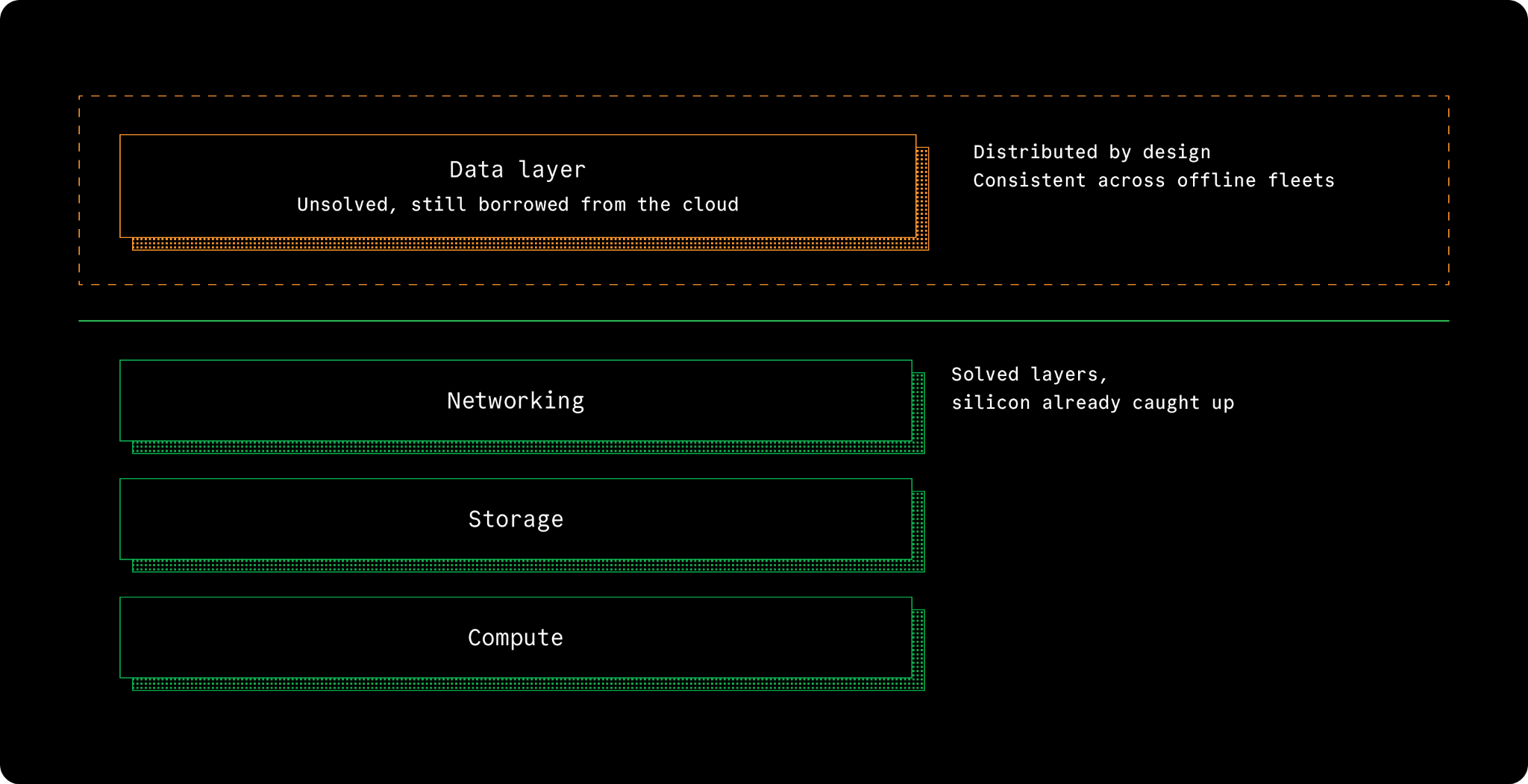
Here is the part most strategies miss. Compute is no longer the constraint. Storage is no longer the constraint. Networking is no longer the constraint. So what is?
The data layer. Edge data management is the unsolved half of the stack.
The chip in the drone can run the model. The radio in the satellite can move the bits. The flash in the inverter can hold the dataset. None of that helps if you cannot get the right data to the right device, keep it consistent across a fleet that is never fully online, control who is allowed to read it, and prove where it came from.
Those are not silicon problems. They are software problems — and today most teams paper over them with brittle sync scripts and retry queues, because everyone assumed the constraint lived somewhere else. If your organization has built anything serious for the edge in the last two years, you have already hit this wall. The model runs. The device performs. The thing that breaks is the data layer underneath, almost always borrowed from a cloud architecture and asked to do a job it was never designed for.
The conversation worth having
The edge is ready. The question is no longer whether devices can think — it is what data infrastructure a ready edge actually requires: one that is distributed by design, keeps data consistent across intermittently connected fleets, enforces access at the edge, and proves provenance without phoning home.
That is exactly the layer Source is building. DefraDB is a distributed, local-first database with peer-to-peer networking, conflict-free replication, and content-addressable storage — infrastructure designed for the edge from the ground up, not extracted from the cloud and forced to cope.
The capability conversation ended when the first accelerators shipped at scale. The infrastructure conversation is just beginning. The organizations that have it first will build on ground the rest of the market is still pretending is solid.
Ready to rethink your edge architecture? Explore what a purpose-built edge data layer looks like at docs.source.network.


