


Memory at the Edge: Why On-Device AI Has to Own Its Own State
Strip the memory away from an AI agent and what's left is a stateless text transformer. Tokens in, tokens out, nothing retained. Every model works this way, from the largest frontier system to the smallest model running on a phone. The intelligence people attribute to agents lives mostly in the data around the model, not in the weights.
Most leaders don't realize how much of an "AI agent" is actually a database. The model is the smallest part. The agent is the memory.
Cloud-first AI papered over this by keeping that memory on a server. That works when the agent is a chat window backed by a data center. It fails the moment the agent runs on a robot, a car, a ship in the middle of the Pacific, or a factory floor with no outbound internet. Edge AI has to own its own state, or it isn't an agent — it's a function call.
The Model Doesn't Remember Anything
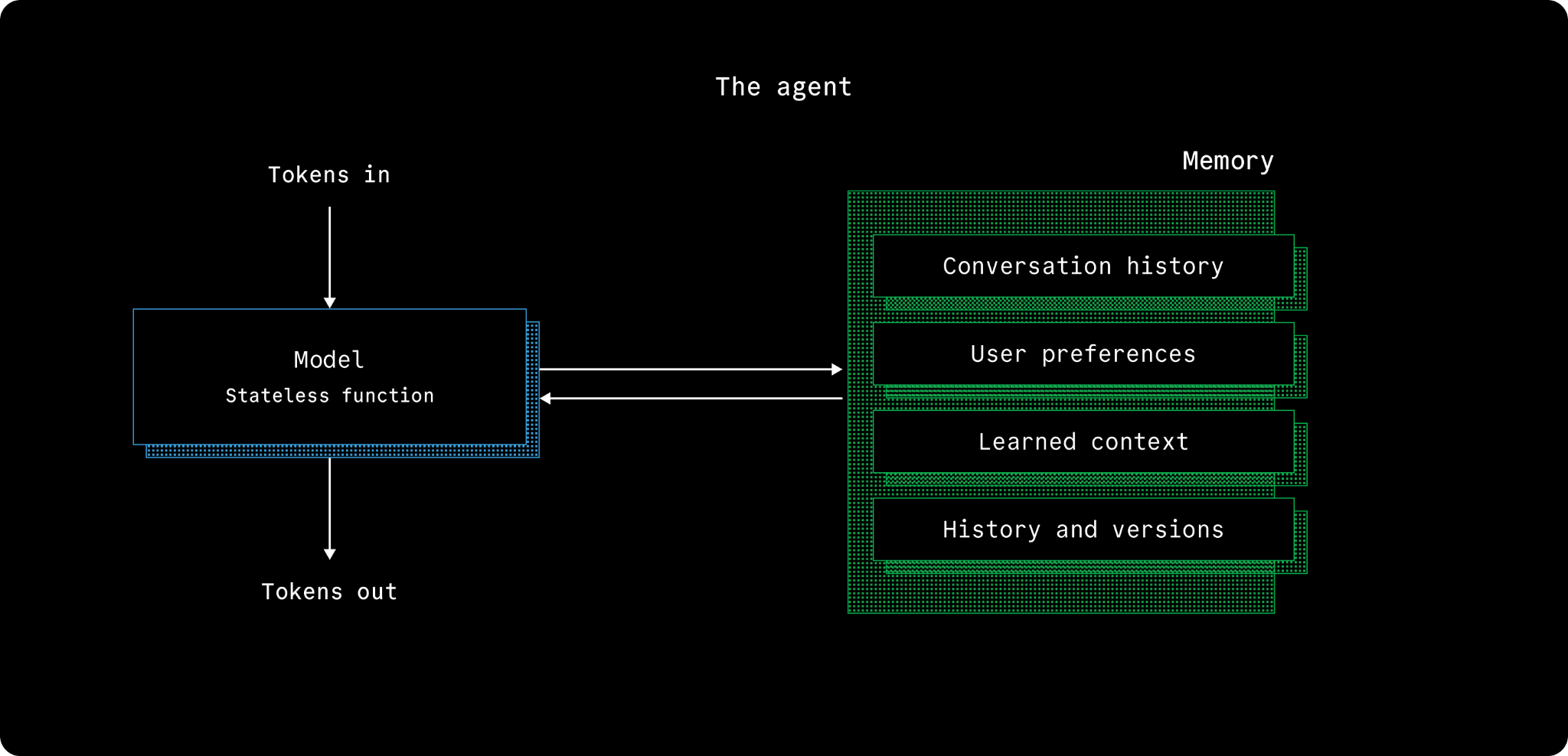
Run a model twice with the same prompt and it has no idea it has seen you before. A model is a pure function: input maps to output, and nothing persists between calls.
Everything that makes an agent feel like an agent lives outside the model — memory, context, history, what it learned about you over months of use. All of it sits in the data layer, and the model borrows it one prompt at a time. Every "personalized" agent you've ever used is a database query dressed up as intelligence. The model supplies the language; the data layer supplies the person.
This catches teams off guard. Local runtimes have made it genuinely easy to get a capable model running on a device. The weights load, the tokens stream, and it feels like the hard part is done. It isn't. An agent on a phone that can't remember what the user asked yesterday isn't an agent. It's autocomplete with good manners.
Offline Isn't an Error State. It's Tuesday.
Edge Intelligence runs where the physical world is, and the physical world is hostile to connectivity. Devices go into tunnels, basements, mine shafts, and rural areas far from the nearest tower. Some go into orbit. For anything operating in the physical world, disconnection is the normal operating condition. It's Tuesday.
Cloud-first software treats disconnection as an exception: show a spinner, queue the request, apologize. That posture was survivable when the device was a thin client showing a dashboard. It is not survivable when the device is the agent, because the agent's entire self lives on the other end of the connection that just dropped.
A warehouse robot mid-task can't forget what it was carrying because the network hit a dead zone between two racks. A satellite sees its ground station for a few minutes per pass. And the everyday cases are just as unforgiving: an agent can't lose the thread because the subway went underground. Users don't experience that as a network event — they experience it as the agent forgetting who they are, mid-sentence. Trust is built on continuity, and continuity that depends on signal strength isn't continuity.
Physics compounds the problem. A vision system pulling defective parts off a line gets a few milliseconds per part. A round trip to a data center costs more than that budget before the server has done any work — and no network upgrade changes the speed of light. Memory an agent consults on every decision has to sit next to the compute making the decision, or the agent is always reacting to a moment that has already passed.
What Owning State Actually Requires
The reflexive answer is "cache the data," and it's wrong. A cache is a copy of someone else's truth; it assumes the real answer lives somewhere else. Memory is your own truth — written locally, trusted locally, and carried forward whether or not anyone else is reachable. Owning state means a handful of hard requirements:
- Persistence that survives restarts, app updates, OS updates, and firmware rolls. An agent that loses its history every time the platform ships a patch has no history — it has a mood.
- Writes that are safe with no server to confirm them. If a local write isn't real until a remote party blesses it, the device doesn't own its memory — whoever runs the server does.
- Deterministic reconciliation when the device reconnects to a world that changed. The merge can't be a "last write wins" shrug that silently deletes someone's work. This is where conflict-free data types earn their keep.
- History and versioning, because ordering is meaning. In mission-critical deployments, the agent's memory doubles as its black box — the record a regulator, insurer, or court examines after something goes wrong.
- Data sovereignty by default. Memory that lives on the device never had to leave it. For a hospital system or a classified network that's a hard constraint; for a private assistant it's a choice. Either way, owned state makes it the default.
You Can't Bolt This Onto Cloud-First
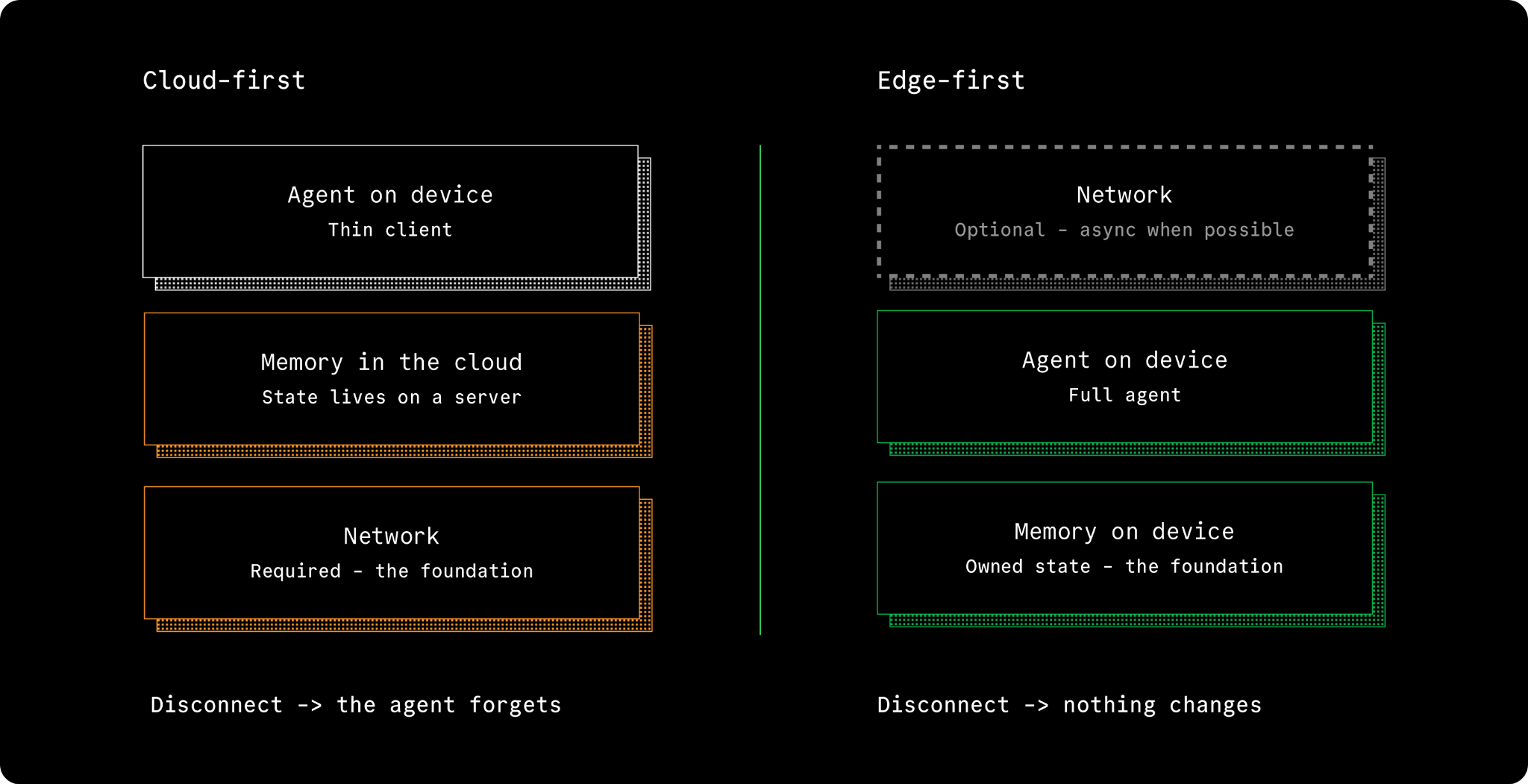
The tempting path is to keep the cloud-first stack and patch it: a local cache for reads, a retry queue for writes, an offline banner. Teams have burned years here, and it never converges, because the assumptions are inverted at the foundation. Cloud-first asks "am I connected?" and then decides whether the software may function. The network is a precondition, baked into the data model, the API contracts, and the failure semantics.
Edge-first starts from the opposite premise: I have data. I will sync when I want to, when I need to, and when I can. The device's own state is the working truth. The network is an optional convenience, sharing is a decision rather than a default, and reconciliation is a first-class operation designed in from the start. One architecture treats the network as oxygen. The other treats it as weather. You cannot get from the first to the second by adding code on top.
The Model Is Becoming a Commodity. The Memory Is Not.
Anyone can run a capable open model on a laptop or fine-tune one in an afternoon. The weights are becoming the most interchangeable part of the stack. What separates an agent from a demo is what it remembers, how reliably, and whether that memory survives contact with the real world — the dead zone, the firmware update, the merge with a world that changed, and the regulator asking what it knew and when.
That's not a model problem. No amount of fine-tuning fixes it. It's a data problem, and it sits in a layer most Edge AI teams haven't started building yet. That layer is where the agent actually lives. Whoever owns the state layer for on-device AI owns the agent experience.
At Source, we are building DefraDB, the database built for the agentic edge.


