


Why Data Is the Bottleneck for the Next Generation of AI
Open any conversation about AI right now and listen for the nouns. Models. Parameters. GPUs. Training runs. Benchmark scores. The whole field is fixated on the same short list, and not one item on it is what decides where AI goes next.
The next decade of AI will be decided by data, not models. Whoever solves the data problem first will define what AI becomes. Everyone still squeezing one more point out of a benchmark is going to lose to whoever builds the layer underneath them.
Models are becoming a commodity
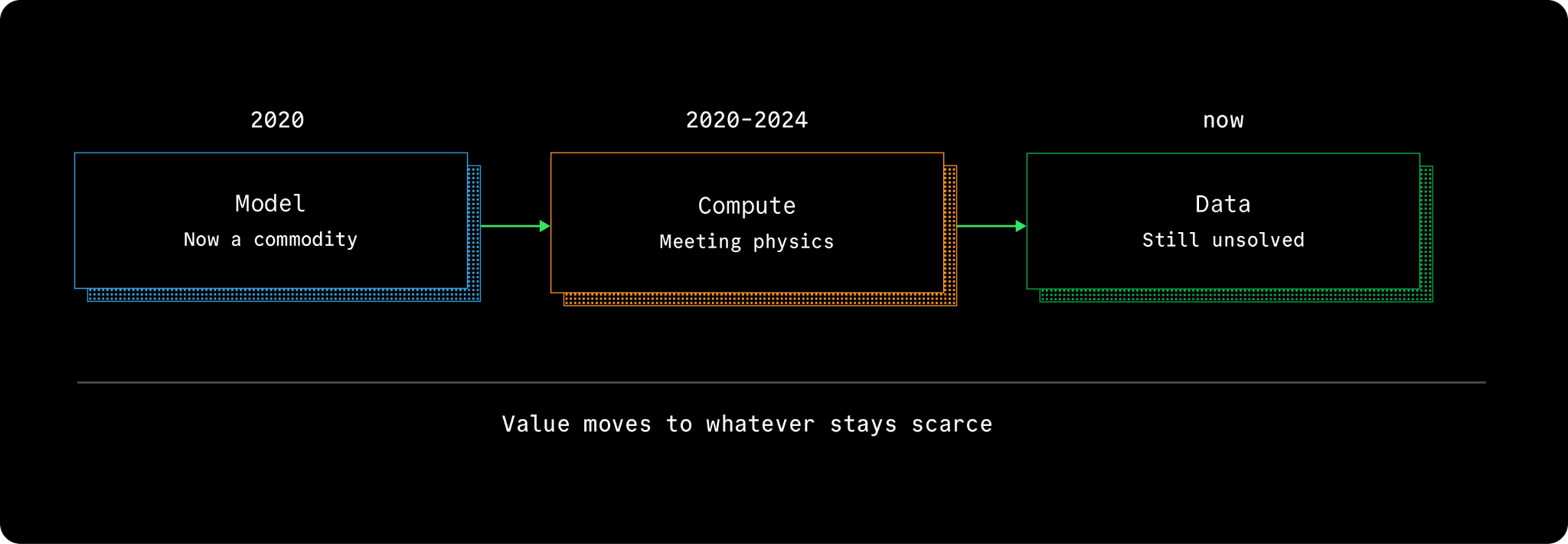
In 2020, the model was the whole game. GPT-3 was a single capability that lived behind a single API, and access to it felt like access to the future.
Six years later the picture is unrecognizable. Meta ships Llama with open weights. Mistral, DeepSeek, Alibaba's Qwen, Google's Gemma. Strong models you can download and run on your own hardware, today, for nothing. The gap between the best closed model and the best open one keeps narrowing, and for most real work it has already closed. Small models now handle tasks that used to demand the largest ones. Fine-tuning is a weekend project. Quantization and distillation let a model a fraction of the size hold its own.
None of this is an accident. It is the oldest pattern in computing. A layer everyone once fought over turns into a commodity, and the value moves to whatever is still scarce. Operating systems went this way. Web servers went this way. The thing people built whole companies around stopped being something you paid for, and the scarce part moved somewhere else. The model is on the same path. It is turning into a part you pick off a shelf, not a moat you stand behind.
If the model is no longer the moat, the advantage has moved. The popular answer for where it went is compute.
Compute is scaling, but it cannot scale forever
For a while, compute was the right answer. From 2020 to 2024 the recipe was simple. More parameters, more data, more GPUs, better results. It worked so well it stopped feeling like a bet.
That run is meeting physics. The largest training runs now cost what only a handful of companies on earth can spend. Power draw has become a national-grid problem, the kind that turns up in energy policy and utility planning. Chip supply is tight enough that NVIDIA's roadmap reads like a geopolitical event. Data center construction cannot keep pace with the demand for it. The exponential everyone extrapolated is running into the physical world.
This does not mean progress stops. It means the easy gains are spent. The next decade will not come from another hundred-fold scale-up of compute. It will come from getting more out of the compute we already have, from running capable AI in places it could never run before, and from building systems that do not hang on one enormous training run inside one company. The frontier stops being raw scale. It becomes deployment.
And the moment you try to run AI out in the real world, you hit a wall almost no one is talking about.
The unsolved problem is data
Cloud AI was built on one quiet assumption: that data flows freely to wherever the model runs. You pulled everything into one place, ran the model there, and sent the answer back. Every hard question about data, where it sits, who can see it, how it moves, what is allowed, got answered the same lazy way. Put it all on one company's servers and trust that company.
That assumption is false everywhere AI is now going. It breaks on the phone in your pocket, in the car, in the hospital, on the factory floor, on the robot. And when it breaks, a stack of problems the cloud hid for fifteen years comes due all at once.
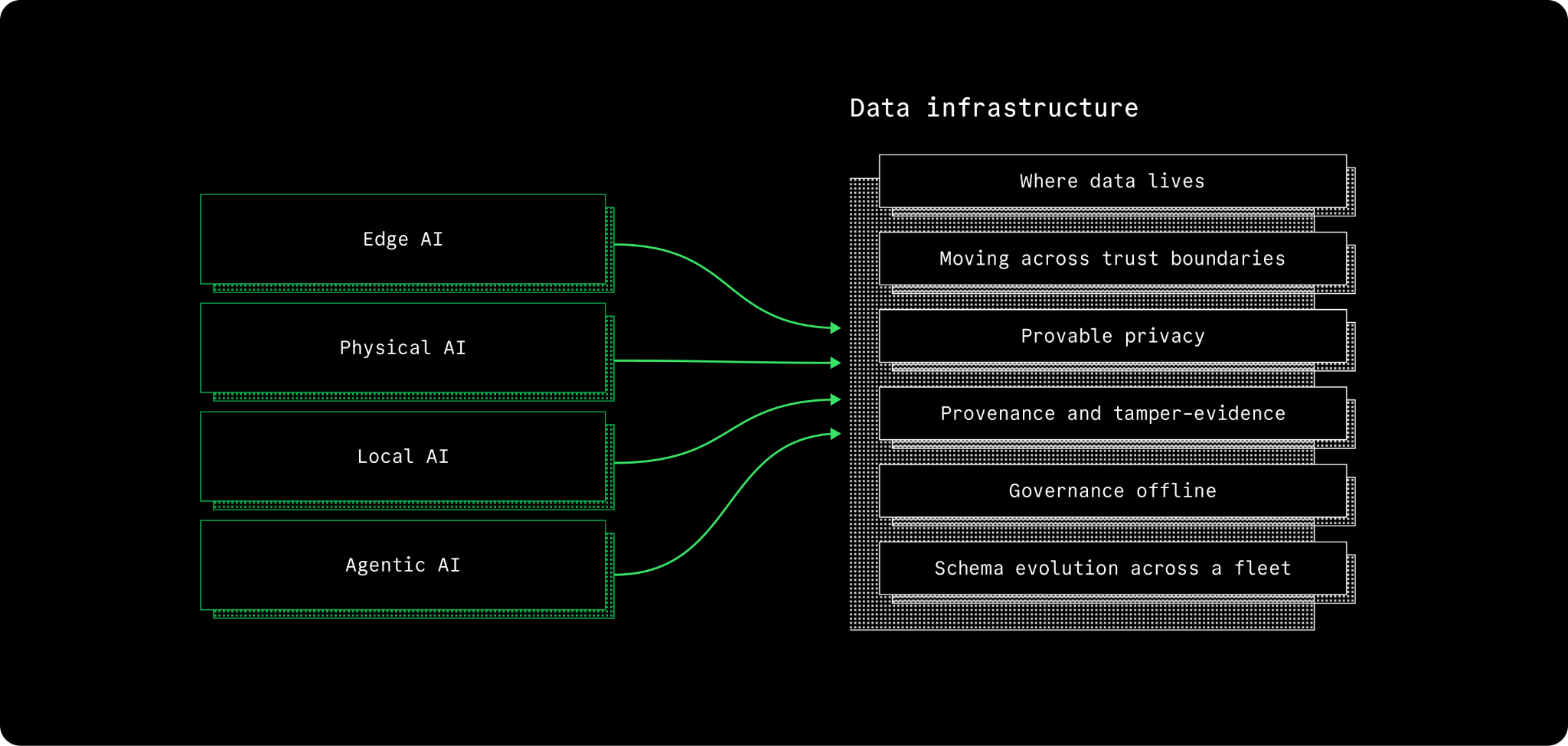
Start with where data lives. Privacy law, plain bandwidth physics, and what users now expect are all pushing data to stay where it was made. You cannot stream a sensor feed to a data center and back inside a control loop, and more and more, you are not allowed to move it at all. The data layer has to live where the data lives, which is no longer the cloud.
Then there is movement. The cloud moved data between parties by routing all of it through the middle. Out here there is no middle. A phone, a car, a hospital system, a peer device, all of them need to share what matters across a trust boundary without dumping everything into one shared pile. The infrastructure to do that, to move data between parties who do not fully trust each other and never pool it, does not exist at any real scale.
Privacy stops being a promise. In the cloud, privacy was a sentence in a contract and a logo you chose to believe. As AI starts acting on its own, on your device, on your behalf, belief is not enough. Privacy has to become something a system can prove, a property you can check, not a pledge you take on faith.
So does trust in the data itself. When an agent acts on a record, when a model trains on inputs from a thousand strangers, when a decision turns on a number that arrived from a peer you have never met, you need to know where it came from and whether anyone touched it on the way. Provenance. Tamper-evidence. Real identity at the level of the data. None of it is solved underneath the systems being shipped today.
Then governance, which is where it gets genuinely hard. Agents are taking actions for people, more of them every month. What rules bound those actions? Where do the rules physically live? How do you enforce them when the agent is offline, sitting on a device, riding on a robot with no connection to anything? Governance written for one company's servers has nothing to say out here.
Underneath all of it sits the unglamorous one: change. The cloud assumed one schema, one version, one migration you ran on a Tuesday night. The new AI runs on thousands of devices across a dozen software versions that update whenever they happen to be online. Evolving the shape of your data across a fleet like that, without breaking the devices that have not caught up, is an open problem most teams have not even reached yet.
Here is the part that matters. These are not separate problems. They are the same problem seen from different angles. The data infrastructure for AI that runs outside the cloud has not been built yet. And the AI that is going to matter most over the next decade is exactly the AI that runs outside the cloud.
Same wall, different doors
The names keep multiplying. Edge AI, physical AI, local AI, agentic AI, and a fresh one every quarter. Different markets with different buyers. One architecture problem underneath all of them.
The model runs on the device. The compute is there. The demand is real, from users who want their data to stay theirs and from products that cannot afford a round trip to a data center. What is missing in every case is the same thing: a data layer that lets the system work as a product instead of a demo. The team shipping an on-device assistant, the engineer wiring up a robot, the founder dropping a local model into their app are all standing in front of the same wall, and the wall is data infrastructure, not compute.
Look at where the real moats already sit. Apple's on-device AI is fenced in by the data architecture Apple spent a decade building around it, not by the model. The model is the part anyone can match. The data layer is the part nobody can. Tesla's self-driving program lives or dies on data infrastructure, on how fleet observations get collected, labeled, versioned, and turned into the next model, and the same holds for every serious robotics effort shipping today. And the local AI tooling developers actually love, Ollama and MLX and llama.cpp, nailed the runtime and stopped there. None of it has a real answer for where the data lives, how it syncs, how it gets shared, or how it is governed. That gap is why a wall of brilliant local AI demos never turn into products.
Every one of these tells the same story. The model is not the bottleneck. The data is.
How to think about AI from here
If you build, fund, or ship AI, the questions worth asking just changed.
Stop asking which model to use. Start asking where your data lives and how it moves. Stop tuning for a benchmark. Start designing for the whole life of the data your model runs on, from where it is born to where it travels to who is allowed to see it. Stop picturing AI as a model wrapped in an API. Start picturing it as a system whose entire value rests on the data infrastructure underneath it.
The model layer is settling into a commodity, the way every infrastructure layer eventually does. Compute is hitting the wall physics always had waiting for it. What is left, the part that is unsolved and hard, is the data. Whoever builds the data infrastructure for AI that runs outside the cloud is building the ground the next decade stands on.
That is the whole bet. We think it is the right one.
At Source, we are building DefraDB, the database built for the edge.


