

A robot spends twenty minutes inside a collapsed building. It learns which floor shifts under weight, which wall is load-bearing, where the stairwell used to be. A second robot arrives at the door, and there is no way to hand any of that over. The knowledge lives as activations inside a running process on the first machine. So the second robot goes in cold and relearns the hazard the hard way: with a wheel.
This is the quiet gap at the center of today's AI systems. We have gotten very good at building models that understand the world in the moment. We have barely started on the part that lets that understanding persist, be questioned, and travel.
What a world model actually holds
A world model predicts what happens next. Feed it what it sees plus an action, and it returns a plausible next state. To do that it carries a compressed internal encoding, dense enough to keep predictions coherent for a while.
That encoding was trained for exactly one job: drive prediction error down. Nothing ever asked it to be readable. There is no field inside it labeled "stairwell," only a region of math that behaves differently when a stairwell is in view. That is fine while the model is doing its own work. The trouble starts the moment anything outside the model needs to know what the model knows.
A prediction is not a record
The obvious move is to just ask the model. Show it the current scene, roll it forward, read the answer. But that is not a lookup. It is a forward pass inventing a plausible continuation. It will describe rooms no sensor ever saw, with total confidence, because filling gaps with priors is the whole point. A system that treats a prediction as a memory cannot tell a measurement from a guess. The failure never looks like an error. It looks like a confident, correct-sounding answer that nothing ever verified.
And you cannot ask it half a question. Which objects moved since the last pass? Which conclusions rest on data older than an hour? Those are queries over records with timestamps. A model has no records.
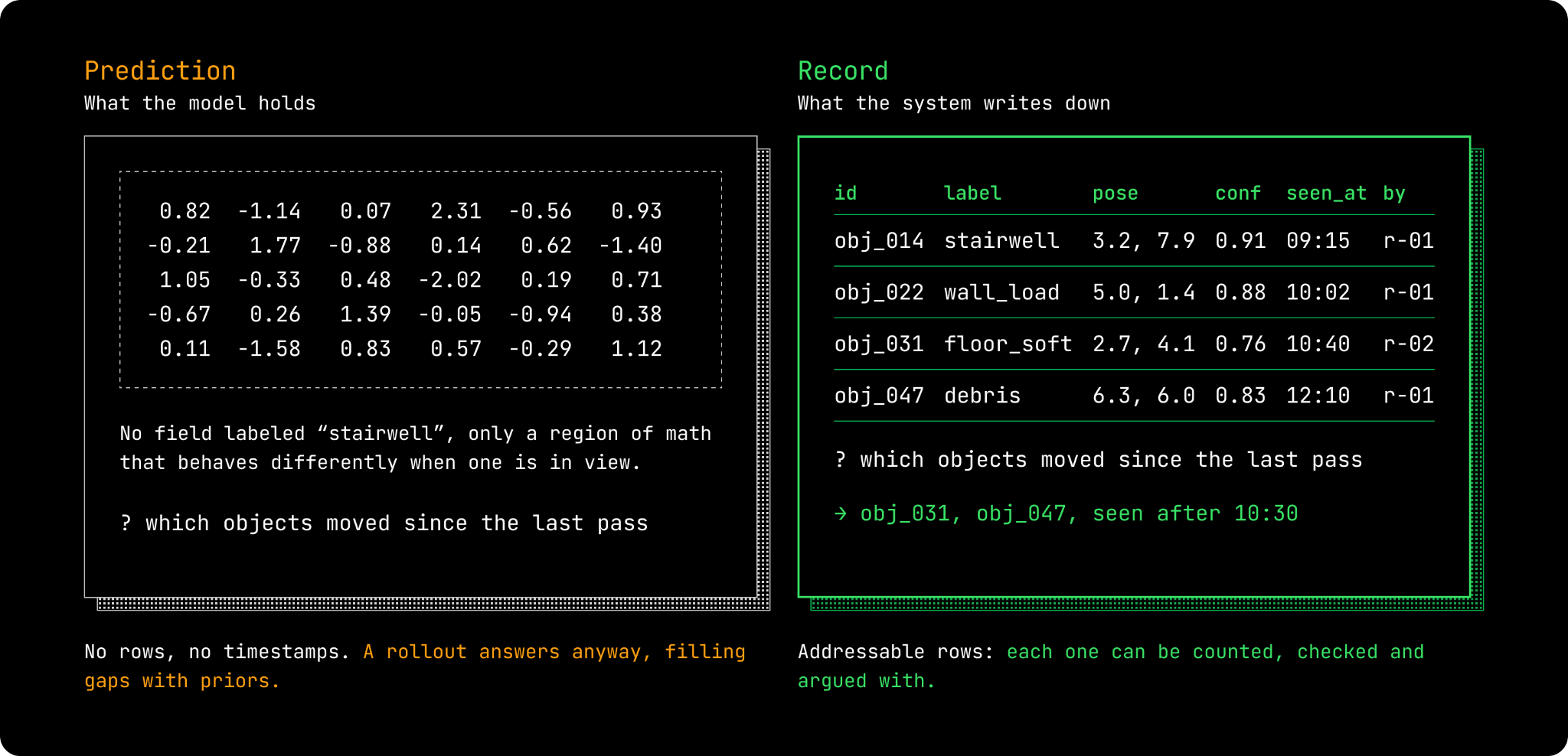 Prediction versus record: a model's latent holds no addressable rows; a record does.
Every real system already writes it down
Here is the tell: nothing actually ships on the model alone. Open any robotics stack and you find a second representation running alongside the network, a map, a scene graph with stable IDs, a list of objects with labels, confidences, and timestamps. That projection is the world the machine actually acts on. The planner reads it. The operator inspects it. It survives a restart. It is the only thing that can be handed to another machine.
So the most consequential code in the stack is the step that turns fuzzy prediction into a stored fact, and it is usually the least deliberate. How confident must a detection be before it becomes a fact? How long does a fact outlive the last time anything saw it? What happens when the next observation disagrees with what is already written? Every system answers these. Most never decided them on purpose. It is a data problem wearing a machine-learning costume.
The two clocks nobody keeps
Every stored belief has two timestamps: when the observation happened, and when the record was written. On one machine running live, they sit almost on top of each other, which is how teams get away with keeping only one for years.
Everywhere else they split apart. A robot that worked two hours out of network range writes its morning observations in the afternoon. Keep only the write time, and a stale belief refreshed by a sync looks freshly seen. Sort by it, and older information quietly outranks newer. Nothing in the table shows anything went wrong. Nothing ever will. The field that would have settled it was thrown away at write time, hours before anything tried to reconcile.
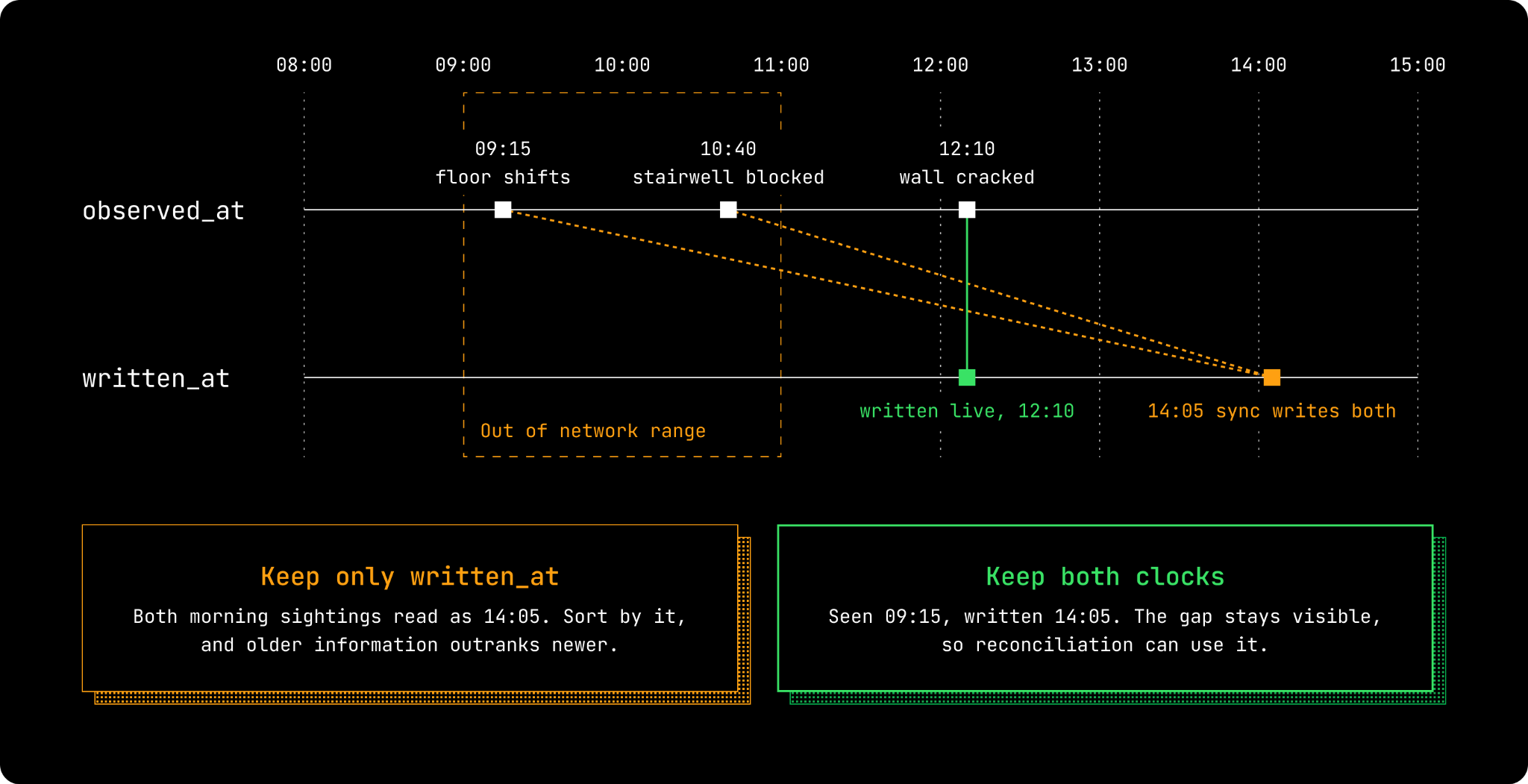 Two clocks per record: when it was observed, and when it was written.
The record outlives the model
Models get swapped: new checkpoint, new labels, recalibrated confidence. The site does not reset to match. A construction robot a month into a job is not running a smarter model than the day it arrived; it is running the same model against a far richer record of that specific site. That record is the asset. Nobody trained it. Whether it survives the next model upgrade was decided long before, by whoever chose how it was stored.
This is the strategic point for anyone deploying agents at the edge. Prediction will keep improving. Rollouts will hold together longer. None of it touches the shape of this problem, because the thing that has to persist, be queried, carry its provenance, and cross from one machine to another was never inside the network to begin with.
The second robot at the doorway does not need the first one's competence. It needs its records: this object, at this pose, seen at this time, by this unit, at this confidence, last confirmed on this pass. Weaker than understanding, and far more useful. It can be checked before entering. It can be argued with. It can be added to, so the third robot arrives better off than either.
The world model a robot acts on is not the model. It is what the model wrote down.
At Source, we are building DefraDB, the distributed database built for the agentic edge. Conflict-free data types and content-addressable storage, so the record every edge AI depends on can persist, carry its provenance, and sync across every machine that needs it.


