


Two satellites from two operators are converging, 700 kilometers up. Their collision-avoidance agents settled it hours earlier: one holds, the other yields. Then the predicted miss distance collapses, both fire emergency burns, and both operators lose years of propellant in a night. Each blames the other. Both agents kept a complete, ordered, signed record of what they saw and did. Each record shows its own craft on the agreed path and the other one drifting off it. Neither has been tampered with. Neither is lying. They disagree anyway, and at that altitude the only witnesses are the two machines that were part of it.
Every investigation reduces to one question: what did the agent know, and when did it know it? That question always assumed a single agent. That assumption is about to fail everywhere at once.
The question now runs both ways
When AI agents are as common as the chips they run on, an event with a single witness becomes the rare case. Every orbit, every worksite, every property line has more than one agent watching, and each belongs to someone with something at stake. So before any regulator or court asks the question, the parties ask it of each other. Each side wants the other's record, because its own reconstruction is incomplete without evidence held by the party it is disputing.
That changes what the record you write today is for. You built it to answer your own postmortem. It will be read next to another machine's memory of the same seconds, by a team on the other side paid to find the difference.
One record is only a story
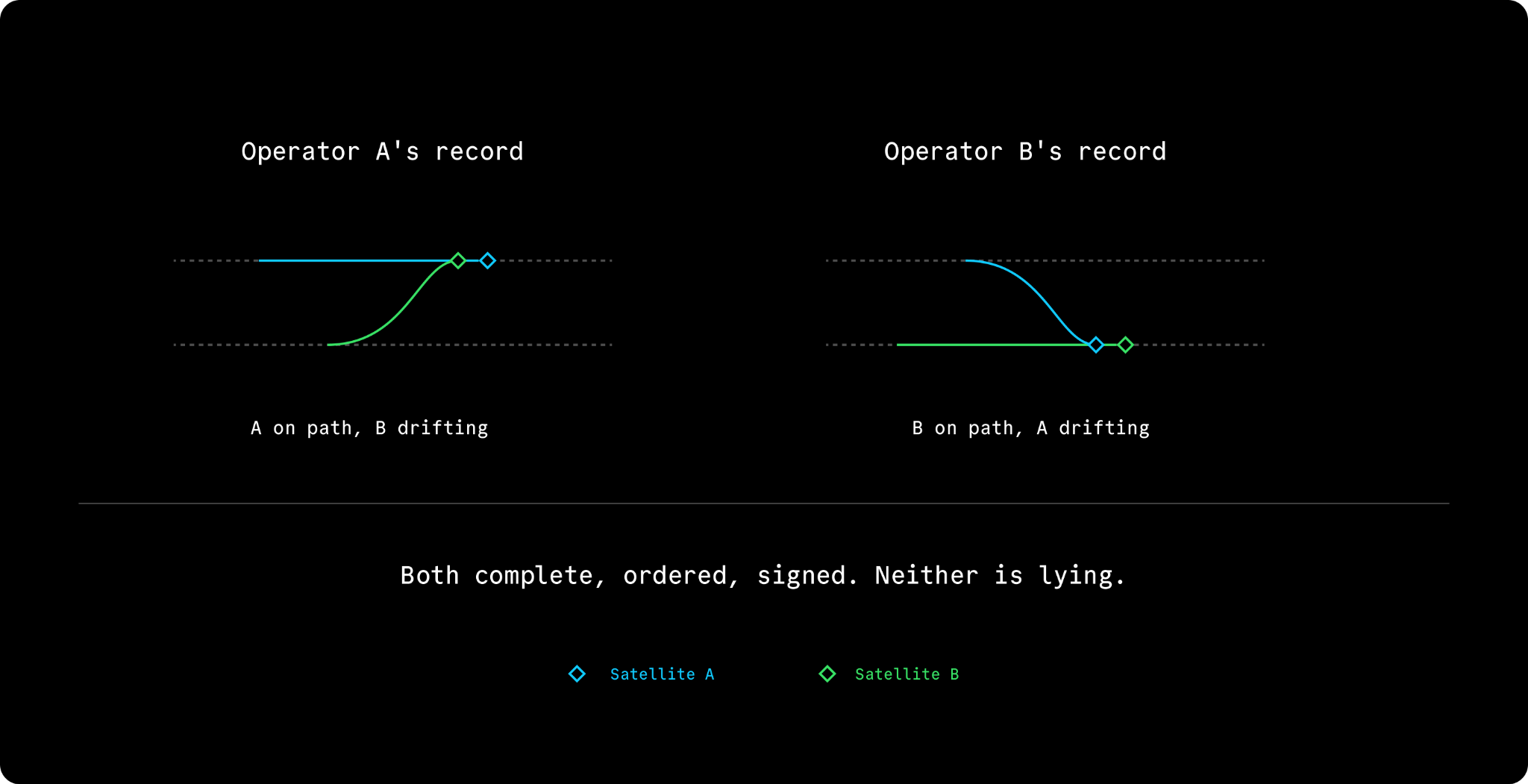
Even a perfect record is a single witness. Complete, ordered, tamper-evident, survivable: the four properties that make a record evidence, and all four together still produce one side's account. A black box proves what its own agent perceived. It cannot prove the perception was right. One of those two satellites measured the world wrong, and its record faithfully preserved the error.
Corroboration is the stronger standard, and it is the one the physical world has always used. Two independent records, held by parties with opposing interests, that agree. Agreement is powerful because neither side could have manufactured it alone. Engineers already trust this: two independent measurements beat one precise instrument, because the failure modes do not correlate. When a contractor's crane agent and a surveyor's drone record the same load swinging through the same arc, the sequence stops being anyone's claim. It is the closest thing to ground truth an investigation gets.
Disagreement is not failure either. It is diagnostic. When a ground robot reports a structure stable and the drone above it reports movement, the divergence is not noise to average away. It points at the exact place where one sensor or one model went wrong, which is exactly where the investigation should look.
Records can only agree if they can be compared
Corroboration has a precondition so basic it is easy to miss. Before two records can agree or disagree, they have to be comparable, and most are not.
Two neighboring farms run spraying drones from different vendors, and a drift dispute reaches the property line. One cloud sampled position twice as often as the other. One pipeline stamps events when they happened, the other when they were uploaded, hours later. The schemas share no vocabulary. None of these were mistakes. Each was a reasonable choice by a team that assumed its record would never leave its own dashboard. What lands on the table is not two witnesses. It is two press releases.
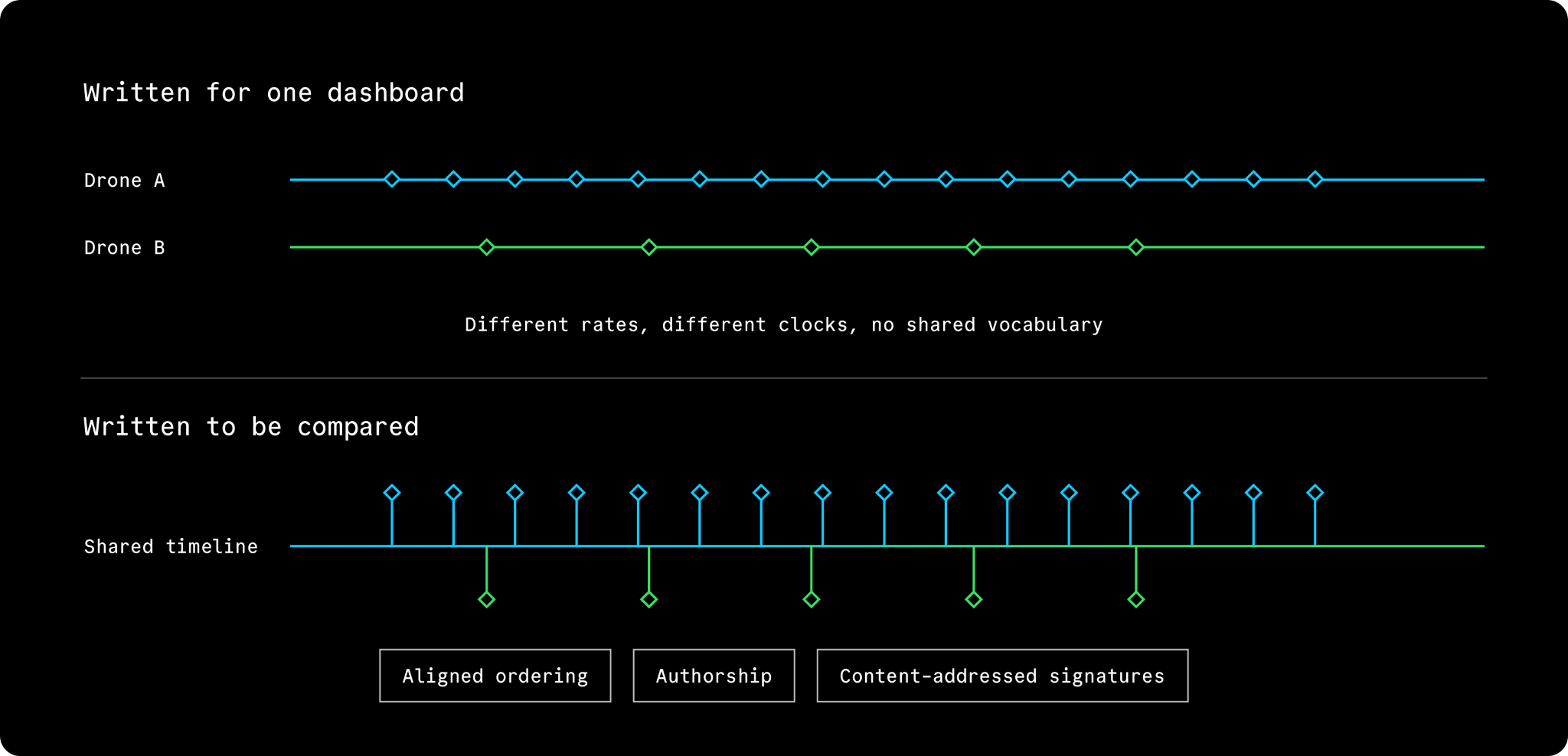
Comparison needs properties, the same way evidence did. An ordering that can be aligned across records, so both accounts sit on one timeline. Authorship, so every event answers to the agent that wrote it. Signatures that survive leaving their author's hands, so a record handed to the other side is still worth reading when it arrives. This is where content addressable storage earns its place: name data by its contents and any copy proves its own integrity, in anyone's custody. All of it is decided in the write path, long before any encounter, because no engineering after the incident can add properties the record was never written with.
Every agent is already a witness
At ubiquity, agents perceive each other constantly. The record of any encounter is already being written by every party to it, at the edge, at the same moment, from different angles. Nobody has to build the corroboration network. It is a side effect of agents keeping the memory they already need. If you are building an agent, you are building a witness. The only question is whether it is a credible one.
Memory built right was a black box for free. Evidence built right is corroboration for free, and it holds with no motors anywhere. A procurement agent and a supplier's fulfillment agent are two witnesses to one order, and a disputed commitment needs exactly the alignment a disputed conjunction does.
Most incidents at ubiquity will never reach a courtroom. They will be settled between black boxes: two records laid side by side, agreement found, responsibility assigned, partnership intact. The organizations whose records can meet the other side's will resolve disputes in days and keep deploying. The ones whose records cannot be compared end up in court, arguing about clocks.
At Source, we are building DefraDB, a distributed database for the agentic edge.


