

The Local AI Revolution: When the Model Lives on Your Device
You are almost certainly reading this on a phone. That phone is running a language model right now, as you read this, on the same device showing you these words. Not in a data center it talks to. On the machine in your hand. Apple put one on its current iPhones, iPads, and Macs. Google put Gemini Nano inside Chrome and Android. Microsoft built Phi into Windows. This is not a research preview or a waitlist. It is shipping infrastructure, already in your pocket.
For developers, the shift is bigger than a new API. In the last 18 months the toolchain for running models on personal hardware went from a weekend hobby to a production stack. Ollama turned "run a model locally" into a single command and crossed millions of installs doing it. llama.cpp made inference on a plain laptop CPU not just possible but fast. MLX gave Apple Silicon a real ML framework. WebLLM and the Chrome Prompt API turned the browser itself into an inference runtime.
The chips are fast enough. The models are small enough. The runtimes are good enough. NVIDIA's RTX Spark puts a petaflop of AI compute into a slim laptop, enough to run a 120-billion-parameter model on battery, the kind of work that meant a data center a couple of years ago. The technical reasons that once forced inference into the cloud have expired.
And yet look at what has been built on top of it. Almost nothing that resembles a real product. A lot of impressive demos. A lot of "look, it works offline" screen recordings. Very few applications a normal person would come to depend on. The capability is fully shipped. What people build on it keeps stopping just short of a product.
That gap is what this piece is about. It is not a model problem. The models work. It is a data problem, and nobody has solved it yet.
Nobody is doing this for ideology
It would be easy to read the move on-device as a values play, privacy-minded people wanting their data to stay home. It is not that. Look at who is actually doing it, and why. The chip makers want it, because inference on the device sells the device. Product teams want out from a cloud bill that grows with every user they add. And the most telling group of all, the companies that run the biggest clouds, are doing it too: Microsoft and Google are putting models on the device, competing with the compute they would rather rent to you. When even the landlords undercut their own rent, the reason is not ideology. It is that the numbers stopped working in the cloud's favor.
We made that case in full in AI Is Leaving the Cloud and The Cloud Tax: the economics, the latency the network cannot beat, the privacy a user can verify instead of take on faith, the way the cloud turned into a single point of failure for things that are not dashboards. No need to run it again. One part is worth pulling out, though, because it is what a developer feels on day one. A cloud model is a network request your app fires off and waits on, with the spinner, the timeout, and the retry that come with one. A local model is a function call inside your own program, answering at the speed the screen redraws. It stops being a remote service and becomes part of the app, callable on every keystroke or in the background.
None of this is what the piece is about. The point is what happens when you try to build on it.
This is not a toy
Forget the demos and think about what the shipped runtimes make possible. A writing assistant that reads your draft and never sends a word of it anywhere. A code model in your editor that completes the function you are writing without your private repository leaving the laptop. A voice interface that answers without a byte of audio touching a server. These are not watered-down cloud apps. For many users they are the better one, because the question that made them wary of AI at all, where does my stuff go, finally has an answer that is not someone else's computer.
Go further. A model that answers questions about your own notes, messages, and files without that corpus going anywhere, and an agent that picks up where it left off last week.
Every one of these is buildable today. The model is handled. The inference is handled. You can stand up a working version in an afternoon. And then you try to turn that demo into something real, and you hit the wall.
The wall
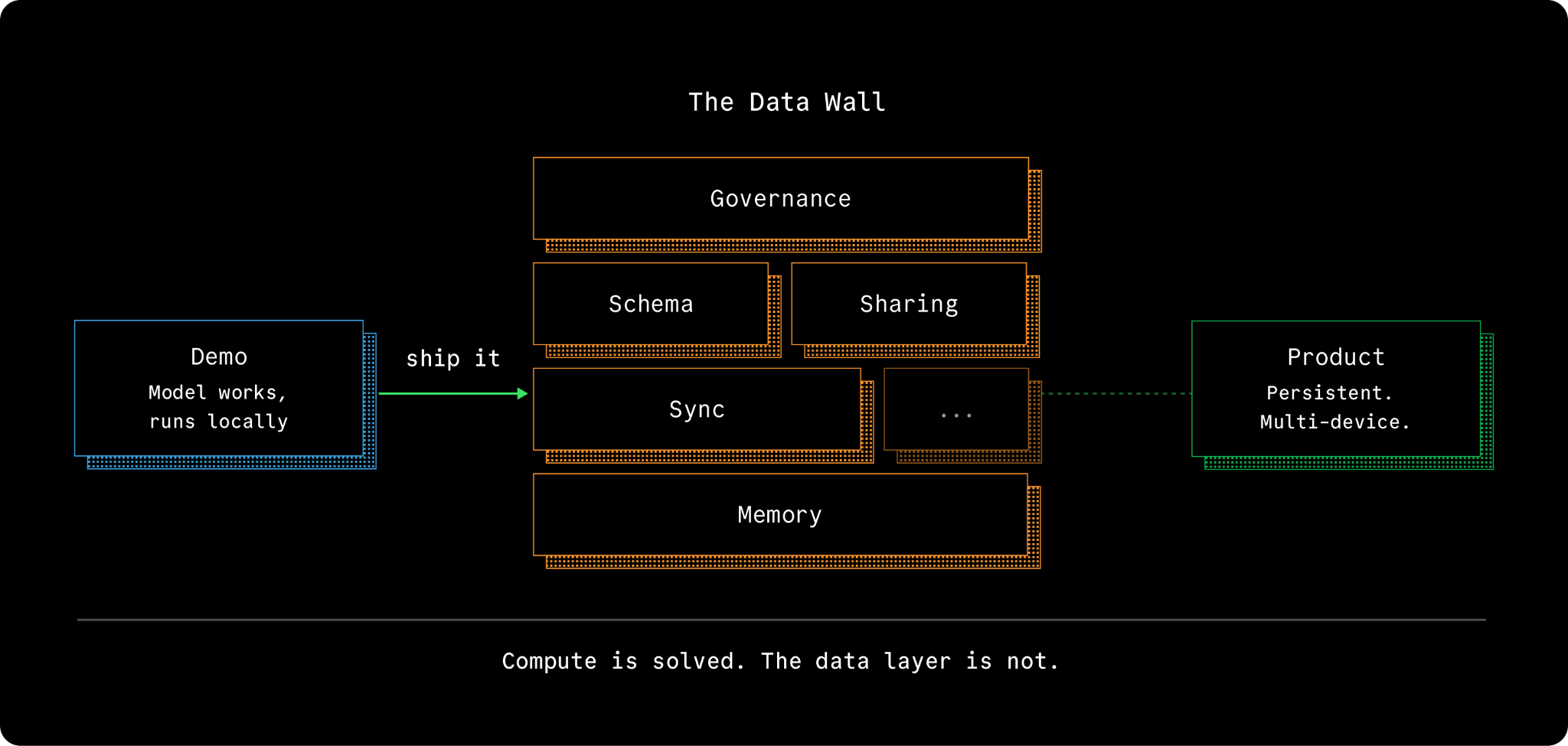
Get a model running on a device and you discover what everyone discovers: the model was the easy part.
The wall has nothing to do with inference. It shows up the moment you ask the model to do something a product has to do, and it is always the same shape. The model is stateless. Your product is not. And there is nowhere obvious for the state to live.
The obvious answer is a server, and that is the trap. Make a server the place the data lives and gets reconciled, and you have rebuilt the cloud you just left. The data is off the device again, the privacy you promised goes with it, and you are paying for uptime you do not control. You moved the model and kept the cloud for the part that actually mattered, the user's data. Take the server off the table, and what follows is what is left.
Start with memory. Your agent needs to remember what the user said yesterday, and the model remembers nothing between calls. So that memory has to live somewhere: stored, structured, pulled back when relevant, kept from growing into an unsearchable heap. In the cloud you reach for a database without thinking. On the device, what exactly are you reaching for?
Now make it real, which means more than one device. The user installs your app on their phone and their laptop and expects the AI to know them on both. The conversation from the train this morning should be waiting at their desk. But the state lives on the phone, and the laptop has its own copy of nothing. Keeping two devices in agreement about a shared, changing dataset, without routing it all through the server you were avoiding, is genuinely hard. "Just sync it" is not a solution. It is the name of the problem.
Then someone wants to share. A user wants to hand a conversation, a project, a memory to someone else. The cloud app puts the shared object on its server. Where do you put it when the entire point was that the data lives with the user? Sharing between people whose data sits on their own devices, with real control over who sees what, is not a feature you bolt on at the end. It is an architecture you either have or you do not.
Schema evolution finds you next. You ship v1 with one data model, then v2 has a better one, and your users are spread across both. The data on their devices is shaped like the old world, and there is no server-side table to migrate in one shot. Every device is its own little migration that still has to understand all the others mid-rollout.
Under all of it is a governance problem the cloud handled quietly and local AI does not. You told the user their data stays on the device. Can you prove it? Is there a record of what got read, by what, and when? And once you let an agent act for the user, what is it allowed to touch, and how is that enforced when it runs offline with no server to ask? An agent with reach into a user's entire life and nothing governing it is not a product. It is an incident waiting to be written up.
There is more past that. RAG over private data raises every one of these questions at once: how do you index a corpus that cannot leave the device, keep it fresh as files change, and version it as the model and schema shift underneath. Improving from real usage hits the contradiction at the center of it all. You want the AI to get better the more it gets used, and you cannot collect the data it would learn from.
You do not hit all of these on day one. You hit one, patch it with tape, hit the next, and somewhere around the third you realize they are not separate bugs. They are the same missing thing wearing different masks.
Compute is solved. Data is not.
For two years, nearly all of the energy in local AI went into making the model run. Shrink the parameters. Quantize harder. Squeeze out more tokens per second. That work paid off, and as a frontier it is basically finished. The model runs. On a phone, in a browser, on a five-year-old laptop, the model runs.
None of that progress touches the wall. You can double your tokens per second and still have nowhere to put the user's memory. You can quantize to four bits and your two devices still will not agree on the state. The thing standing between local AI and real products was never compute. It is data.
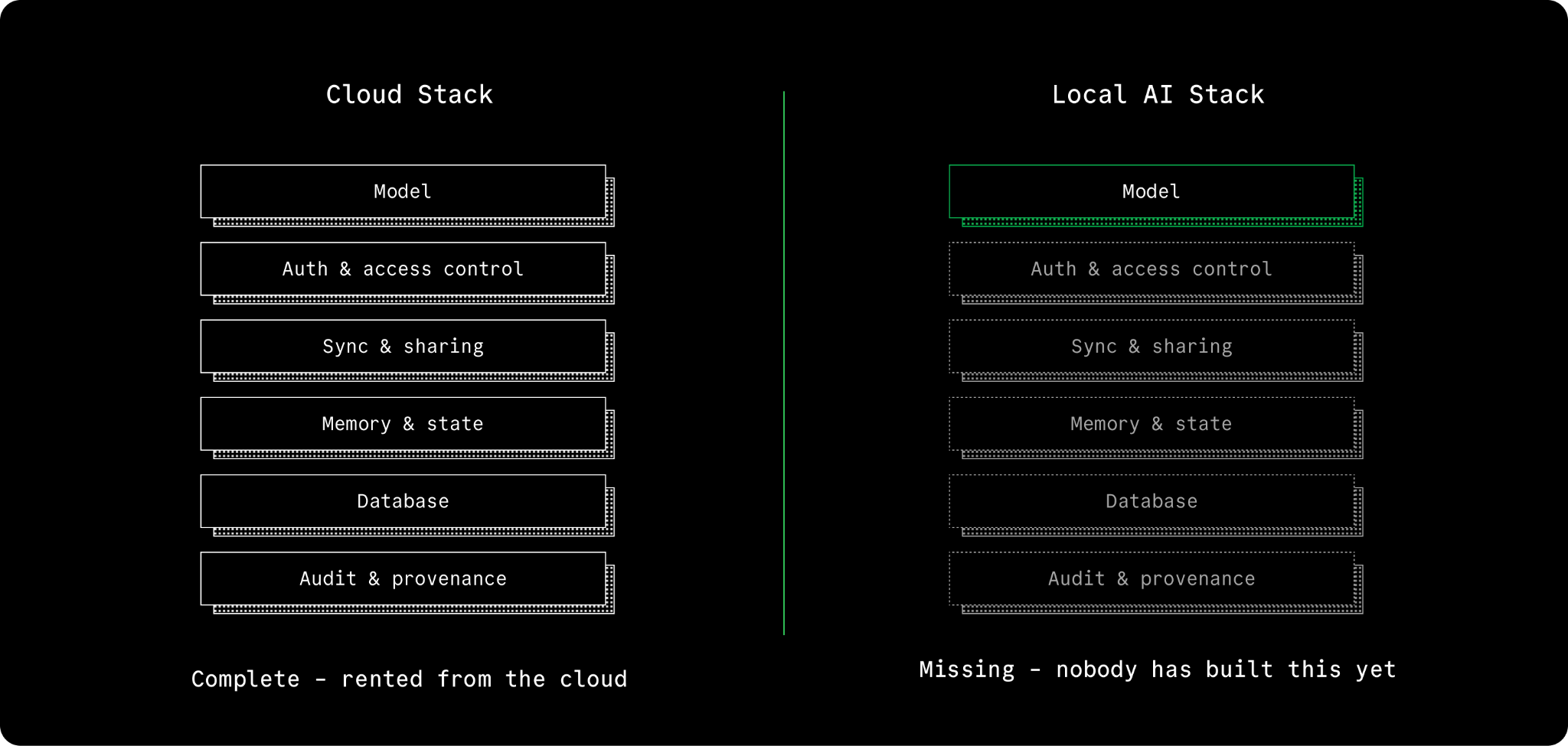
This is what the cloud era hid. In the cloud, the model was one piece of a stack that already existed. The database, the auth, the sync, the sharing, the audit logs, the access control, all of it sat in the same data center as the model, solved and waiting. Call a cloud API and you are renting that whole stack, and you forget it is there.
Local AI inherits none of it. The model came down to the device. The stack did not. Developers have a model, a runtime, and a chip that can run it, and underneath, where the rest of the stack used to be, there is nothing. Local AI is two steps ahead of its data layer. The runtime works. The compute works. The model works. The data does not.
The shape of the missing piece
You can describe the missing piece precisely, just from what the wall demands. It has to live on the device. It has to keep many devices in agreement on their own, reconciling a shared, changing dataset without a server in the middle, and that cannot be bolted on later. It has to carry its own access control and provenance, enforced locally even when the device is offline. And it has to do all of this underneath whatever model and runtime the developer chose, the way a filesystem does not care which program is writing to it.
That is not a feature list for a product. It is the negative space around every wall in this article, and the gap between what local AI can do today and what it can be built into is exactly the size of that missing layer. Right now that space is empty.
Whoever solves data wins
The model is not the moat anymore. It cannot be. Anyone can pull llama. Anyone can run Whisper. Anyone can fine-tune a small model over a weekend and get something that works. The capability that felt like magic two years ago is now a dependency you install, and a dependency everyone has is not an edge anyone holds.
What separates a product from a demo is everything that is not the model. The memory that survives the session. The state that follows the user across devices. The sharing that works without a server. The access control that holds when the agent is offline. The audit trail that makes the whole thing trustworthy. The boring, load-bearing data work the cloud era took for granted and local AI has to build again from nothing.
The developers who win the local AI era will be the ones who see this first. Not the ones with the cleverest quantization, not the ones chasing another two tokens per second, but the ones who understand that the model was always going to become a commodity, and the real product was the layer underneath it the whole time.
This is not only a local AI story. The same missing layer turns up everywhere AI is leaving the cloud: on robots, in cars, on factory floors, anywhere the compute moved to sit next to the data. Different devices, different markets, one architecture problem.
At Source, we are building DefraDB, the database built for the edge. We get into the data problem underneath all of it in Why Data Is the Bottleneck for the Next Generation of AI.


