


Physical AI Is Coming, and It Will Not Run in the Cloud
The most important AI being built today works in fleets and swarms the cloud cannot referee.
Two robot cars are stuck on a narrow San Francisco street, bumpers touching, one of them turned sideways across the lane. Neither will move. One had tried to turn around in a dead end, clipped the other, and now both sit frozen. A third robot car rolls up, sees the tangle, and stops dead behind them. The street is blocked. Traffic stacks up. The cars stay put until a Waymo worker walks over, opens a door, climbs in, and backs one of them out by hand.
Look at what just happened. Two cars. Same company. Same software. A meter apart. And they could not work out which one should move. Each car thought it through alone, came up empty, and waited for a human to drive over and fix it. The one thing they could not do was the simple thing. Turn to each other and agree.
That is the real shape of physical AI. Not one clever robot acting alone. Many machines, sharing the same space, that have to agree on what happens next.
This is physical AI. It is the AI that acts in the physical world. Robots, autonomous vehicles, drones, surgical robots, humanoids, and industrial and farm machines. What makes it its own category is simple. It does not just return an answer. It takes an action. And when the action is wrong, the cost is not a bad search result. A car does not stop in time. A blade moves the wrong way. A load drops. The harm is real, and it lands in the real world.
For most of the last decade, "AI" meant "cloud AI." You sent your data up. A model sent an answer back. In "AI Is Leaving the Cloud," we mapped the bigger movement pulling AI out of the data center and into the world. Physical AI is the sharpest edge of that movement, and the part most software people have not looked at closely, because they were watching chatbots. That is a mistake. It may be the most important kind of software being built today.
Look at what is already shipping. Waymo runs about 3,000 robotaxis and gives more than 500,000 paid rides a week. Amazon has more than one million robots working across its warehouses. Tesla is turning a Fremont line over to its Optimus humanoid. Figure's humanoids worked an eleven-month run at a BMW plant. Intuitive's da Vinci surgical system has now been used in more than 14 million operations. This is not a forecast. This is a normal week in 2026.
Here is the claim, said plainly. Physical AI cannot run on cloud-first architecture. Not "should not." Cannot.
The cloud was a triumph. It built SaaS, streaming, and most of the web you use every day. It is very good at the job it was made for. Physical AI is not that job.
But the reason why is not the one most people reach for. They think the problem is the brain. They picture a robot that has to think fast, and they assume the fix is a bigger chip on board. That part is real, and it is mostly handled. Figure's robots run their own motor control 200 times a second, right on the machine. NVIDIA builds a robot brain that runs on a chip inside the robot. The box can think for itself now. That is the easy part.
The hard part is the world all these machines have to share.
A robot does not live alone in a clean room. It lives in a real place, full of other machines, in a world that changes every second. To act in that world, each machine needs the same honest, current picture of it. They have to agree on what is true. They have to settle who does what. They have to trust what the others tell them. That shared picture is the thing physical AI really runs on. And it is the thing the cloud cannot hold.
The rest of this piece is why.
A World That Moves Too Fast for a Referee
Start with the hardest limit there is. Not a budget. Not a vendor. The speed of light.
A round trip to a cloud server and back takes time. In practice, that trip runs about 100 milliseconds or more, and that is before the server thinks at all. For most software, 100 milliseconds is nothing. For physical AI, it is a lifetime.
A car going 100 kilometers an hour covers nearly 28 meters every second. Picture two cars trying to sort out who goes first by asking a server far away. By the time the server answers, both have moved on, and the answer is already stale. Safe driving at highway speed needs the call in under 10 milliseconds. A server cannot run a shared moment that fast. It is not even close.
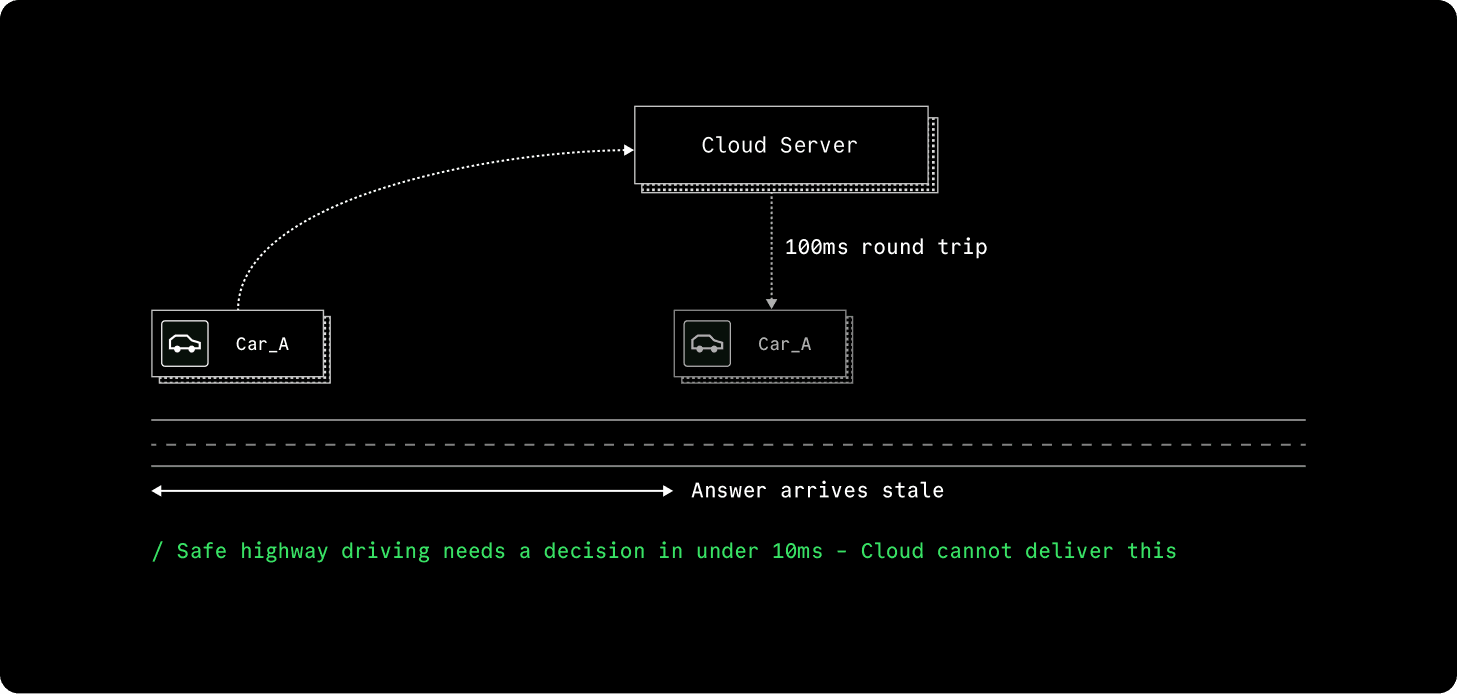
That is the trap with putting the shared picture in the cloud. The world does not hold still while the machines wait. Every round trip is a snapshot of a world that has already changed, and physical AI moves fast. So the picture has to live where the machines are and update between them at the speed of the world they are in. You cannot out-engineer the speed of light. The machines have to keep each other current, right there, with no server in the middle waving them through.
A World That Does Not Wait for a Signal
Say the speed problem did not exist. Say every round trip were instant. The shared picture still could not depend on the cloud, because the machines live in the real world, and the real world drops the connection all the time.
Cars roll into tunnels and dead zones every day. John Deere's self-driving tractors run their work on the machine itself, because a field does not come with Wi-Fi. Skydio built its drones to fly and dodge obstacles on board, even where there is no GPS. Hospitals have weak signal in the very rooms full of machines. A spacecraft is, by definition, not on the network at all.
And the machines are still in the world together when the signal drops. The cars are still side by side in the tunnel. The drones are still flying the same canyon. The link to the cloud is gone, but the need to share a picture and agree on the next move is not. If that picture lived only in a data center, it is gone exactly when it is needed most. So it has to keep working with no uplink. The machines hold it between themselves, keep it current with whoever is near, and fold in what changed when the cloud comes back. Offline is not a broken state to recover from. For physical AI, offline is most of the job.
Nobody Is in Charge, and That Is the Point
So how should a group of machines agree on what to do? The easy answer is to run it all through the cloud. One server holds the truth. One server tells every machine where to go. It is the answer most teams reach for, because it is the answer the cloud taught us.
It is the wrong answer for physical AI, and not by a little. The latency is too high, as we saw. The link is not reliable, as we saw. And worse than both, that one server becomes the single thing that can take everything down at once. A hiccup in a data center should never be able to freeze every robot on the floor. That dependence on a faraway server is its own kind of tax, the Cloud Tax we wrote about earlier. Physical AI just pays it somewhere the bill is broken things, not dollars.
Go back to those two cars in San Francisco. They did not need a data center to settle it. They needed to see each other, share where each one was headed, and agree on who goes first. Right there, between themselves, in the moment it mattered. That is the better answer, and it holds for all of physical AI. The machines talk to each other directly. They share what they see. They sort out who does what. They keep going when one of them, or the link to the cloud, drops out. No single server holds the whole world hostage.
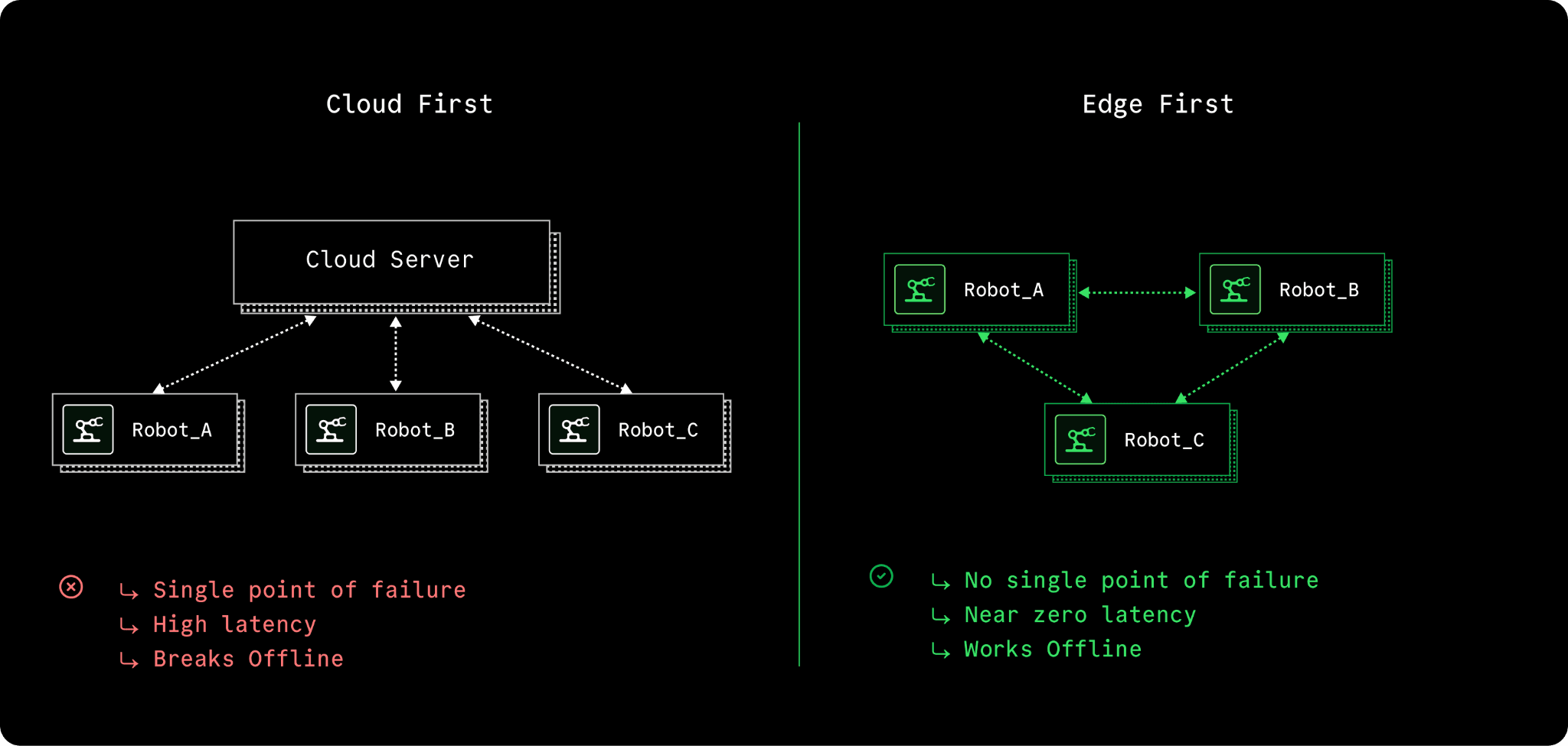
This is hard. Getting many machines to agree on one picture of the world, with no referee in the middle, is one of the oldest hard problems in computing. Two machines can look at the same corner and write down different things. Both can think they have the right of way. Someone has to reconcile that, fairly and fast, with no judge in the middle. Physical AI runs straight into this, and it has to solve it at the edge.
Trust the Machine Next to You
When machines share a world, they share information. And the moment one machine acts on what another tells it, a new question shows up. Can it trust what it just heard.
A car takes the word of the car ahead that the lane is clear. A robot takes a map from the robot that scouted the room. If a bad reading, or a tampered one, slips into the shared picture, it does not stay a data problem. It becomes a crash, or a dropped load, or worse. So each machine has to know where a piece of information came from, and check that it is real, before it bets a physical action on it. And not every machine should get to change everything. Who is allowed to write what has to travel with the data itself, because there is no server standing guard.
Then there is the day after. When physical AI causes harm, the question is not only "what happened." It is "can you prove what happened, and prove every machine was working right when it did." You have to replay the moment across all of them. Europe's new AI and product-safety rules, landing through 2026, make that kind of record a legal duty, not a nice-to-have. That record cannot live in a cloud the machines were never talking to. It has to be built into the data they share, signed and checkable, online or not.
The Shared World Is the Missing Layer
Almost all the attention on physical AI goes to the body and the brain. The hardware, the model, the demo that goes viral. Very little goes to the thing that sits between all the machines and the world they share. The data layer that holds it together.
And that layer is the wall every team hits. They need a shared picture of the world that lives on the machines, not just in a server. It has to sync from machine to machine. It has to take writes from many of them at once and still agree on what is true. It has to keep working offline, control who can change what with no server at the gate, and prove what each machine knew and did.
That layer is not sitting on a shelf. You cannot go buy it. So the biggest players build their own. A robotics team writes its own sync. A car maker writes its own rules for who can touch what. Tesla is going so far as to make its own chips and software layer to run its cars and robots end to end. Each team rebuilds the same hard plumbing, in private, a little differently, and a little broken. The way we see it, that is the real story of physical AI right now. The bodies are ready. The brains are ready. The shared world they all stand on is missing, and everyone is paying, alone, to build it again.
This is the gap. It is, we think, the most important missing piece of software in physical AI today.
The World That Is Already Arriving
Robots are leaving the cage. They are walking into homes, hospitals, sidewalks, farms, and warehouses. Cars are driving themselves past the pilot stage. Drones carry medicine to places roads cannot reach. Soon there will not be one robot in a room. There will be many, working the same space, crossing paths, sharing the job.
None of that runs on cloud-first architecture. The cloud was built for a different job, and it did it well. It was never built to hold a living, shared picture of a physical place, kept true across a crowd of machines, in real time, with no one server in charge. Physical AI needs that picture to live where the action is. On the machines. Between the machines. At the edge.
That architecture already has a name. It is edge-first.


